Current Working Papers
This page presents ongoing research and working papers. Abstracts, presentation materials, and downloadable manuscripts will be added when they are ready for public circulation.
目前工作論文
本頁收錄進行中的研究與工作論文。摘要、簡報資料及可下載稿件,將於適合公開流通時陸續加入。
研究系列 Research Series 1
AI 治理與公共行政研究系列(001–041)八大分類歸屬地圖
| 分類類別 | 類別核心範疇 | 論文編號 | 論文篇名 | 原始議題模組/理論定位 |
|---|---|---|---|---|
| 一、 行政法制、正當程序與制度審計 | 自動化處分、救濟程序、最低實質控制能力 (MSCC)、比較法與制度審計 | 001 | 生成式人工智慧協作研究流程:公共行政中的應用、風險與責任治理 | 議題 01|AI governance & PA |
| 023 | 破除軟法幻覺,建構公部門 AI 治理之最低實質控制能力(MSCC) | 議題 02|Info, Data, Rights & Sovereignty | ||
| 034 | 最終再介入能力的制度化:臺灣、歐盟與加拿大人工智慧治理規範之比較分析 | 議題 07|Research Agenda & Extension | ||
| 036 | 1996–2026資訊社會重訪與七項新研究議題 | 議題 03|Info Society, Digital Dem & Info Gov | ||
| 二、 組織行為、裁量場與官僚動機 | 文官異議、薪酬考核、防禦性脫鉤、分散式行政行動 (DAA)、裁量場、UCPR 與歷史制度沉積 | 009 | 行政異議、專業判斷與 AI 治理能力 | 議題 01|AI governance & PA |
| 024 | 文官薪酬、能力認證、考核與 AI 治理制度誘因 | 議題 05|Incentives, Action & Judgment | ||
| 025 | 形式保障與實質治理功能脫鉤 | 議題 05|Incentives, Action & Judgment | ||
| 026 | 防禦性脫鉤、避責驅動、預設錨定與中層機制 | 議題 05|Incentives, Action & Judgment | ||
| 028 | 裁量場、分散式裁量與裁量可見性 | 議題 05|Incentives, Action & Judgment | ||
| 029 | 公共判斷不可外包、規範轉換與 UCPR | 議題 05|Incentives, Action & Judgment | ||
| 030 | DAA+裁量場+UCPR 統合理論 | 議題 05|Incentives, Action & Judgment | ||
| 039 | 制度的沉積——台灣公共組織行為的歷史生成 | 組織行為歷史演化與制度沉積 | ||
| 040 | 多層行為結構與公務裁量(論文二) | 多層次微觀行為與裁量模型 | ||
| 三、 採購合約、資料履歷與數位主權 | 採購控制權、資料履歷、公共授權治理、跨境智財與預測性行政實質控制 | 010 | 當政府買不到控制權:AI 採購中的資訊權、稽核權與停止權 | 議題 02|Info, Data, Rights & Sovereignty |
| 018 | 誰有權把別人的研究餵給政府 AI?生成式 AI、資料履歷與公共授權治理 | 議題 02|Info, Data, Rights & Sovereignty | ||
| 019 | 誰替臺灣政府向世界說明?生成式 AI、跨境智慧財產權與國家回應能力…… | 議題 02|Info, Data, Rights & Sovereignty | ||
| 022 | 預測性行政下的國家實質控制能力:以宜蘭分署清償率模型…… | 議題 02|Info, Data, Rights & Sovereignty | ||
| 四、 核心治理結構、驗收標準與規範轉換 | 25-3-3-4-7 母架構、治理鏈轉化、上線資格 (OAC) 與技術轉化公共規範條件 | 002 | 重新概念化人工智慧治理:公共行政理論視角下的二十五治理座標 | 議題 01|AI governance & PA |
| 014 | 25–3–3–4–7 母架構系統化 | 議題 01|AI governance & PA | ||
| 016 | 公共價值轉化為治理鏈與制度要求 | 議題 01|AI governance & PA | ||
| 017 | AI 行政應用上線資格/OAC | 議題 01|AI governance & PA | ||
| 035 | 規範何以轉換?人工智慧行政中技術選擇轉化為公共規範的條件 | 議題 07|Research Agenda & Extension | ||
| 五、 政策前瞻、民主正當性與跨學科教育 | 價值內建與協商模式、制度吸收能力、民主正當性、知識落差與典範轉型 | 004 | AI 機器人治理的協商模式:從價值內建到多方共構 | 議題 01|AI governance & PA |
| 005 | AI 治理下的情境推演:以制度吸收能力建構未來政府光譜 | 議題 01|AI governance & PA | ||
| 006 | AI 治理的民主正當性前置條件…… | 議題 03|Info Society, Digital Dem & Info Gov | ||
| 007 | AI 治理下政策體系的情境建構鏈延伸…… | 議題 03|Info Society, Digital Dem & Info Gov | ||
| 008 | AI 治理下公共行政教育的知識落差與能力重構…… | 議題 04|PA, Tech Transformation & Interdisc | ||
| 011 | AI 進入國家議程、民主正當性與政策形成 | 議題 01|AI governance & PA | ||
| 015 | 公共行政教育、跨學科整合、治理能力 | 議題 04|PA, Tech Transformation & Interdisc | ||
| 020 | AI 治理知識體系、碎片化與理論整合 | 議題 04|PA, Tech Transformation & Interdisc | ||
| 021 | 公共行政吸收技術變遷與制度分析典範轉型 | 議題 04|PA, Tech Transformation & Interdisc | ||
| 六、 特定公共領域行政與基礎設施 Governance | 戶籍與身分認定、地籍與產權詮釋、疫情監控、準公共平台與水電算力基礎設施 | 012 | 誰被國家承認?生成式 AI 下的戶籍、身分認定與治理責任 | 議題 02|Info, Data, Rights & Sovereignty |
| 013 | 誰在詮釋土地歷史?生成式 AI 下的地籍、產權認定與治理責任 | 議題 02|Info, Data, Rights & Sovereignty | ||
| 031 | 電子圍籬作為分散式行政行動:以 030 模型 COVID-19 智慧監控系統 | 議題 05|Incentives, Action & Judgment | ||
| 037 | 從私人平台到準公共基礎設施:數位平台國家化治理的制度邊界 | 議題 06|Digital Platforms & Infrastructure | ||
| 038 | 誰為 AI 的電力與水資源負責?運算基礎設施的公共治理 | 議題 06|Digital Platforms & Infrastructure | ||
| 七、 治安警政、人權與國家危機治理 | 深偽(Deepfakes)危機事件判定、認知安全與國家回應機制 | 003 | 深偽何時成為國家治理事件? | 議題 03|Info Society, Digital Dem & Info Gov |
| 八、 學術理論再定位與研究議程 | 「生成—裁量—權威」理論模型建構、公共行政理論再定位、前瞻研究議程與數位治理新路徑 | 032 | 人工智慧時代公共行政理論的再定位:從數位治理到「生成—裁量—權威」 | 議題 07|Research Agenda & Extension |
| 033 | 人工智慧時代公共行政研究議程:從「生成—裁量—權威」模型出發 | 議題 07|Research Agenda & Extension | ||
| 041 | 從多層次分析到行動者共構 ——AI治理下公共組織行為的遞迴重構 | 數位治理與 AI 政策前瞻 |
研究系列 Research Series 2
議題 01|AI治理與公共行政
001|生成式人工智慧協作研究流程:公共行政中的應用、風險與責任治理……
002|重新概念化人工智慧治理:公共行政理論視角下的二十五治理座標….
004|AI機器人治理的協商模式:從價值內建到多方共構
005|AI 治理下的情境推演:以制度吸收能力建構未來政府光譜
009|行政異議、專業判斷與AI治理能力
011|AI進入國家議程、民主正當性與政策形成
014|25–3–3–4–7母架構系統化
016|公共價值轉化為治理鏈與制度要求
017|AI行政應用上線資格/OAC
議題 02|資訊、資料、權利與數位主權
010|當政府買不到控制權:AI採購中的資訊權、稽核權與停止權
012|誰被國家承認?生成式AI下的戶籍、身分認定與治理責任
013|誰在詮釋土地歷史?生成式 AI 下的地籍、產權認定與治理責任
018|誰有權把別人的研究餵給政府AI? 生成式AI、資料履歷與公共授權治理
019|誰替臺灣政府向世界說明?生成式AI、跨境智慧財產權與國家回應能力……
022|預測性行政下的國家實質控制能力:以宜蘭分署清償率模型……
023|破除軟法幻覺,建構公部門 AI 治理之最低實質控制能力(MSCC)……
議題 03|資訊社會、數位民主與資訊治理
003|深偽何時成為國家治理事件?
006|AI治理的民主正當性前置條件……
007|AI治理下政策體系的情境建構鏈延伸……
036|1996–2026資訊社會重訪與七項新研究議題
議題 04|公共行政、科技轉型與跨學科整合
008|AI治理下公共行政教育的知識落差與能力重構……
015|公共行政教育、跨學科整合、治理能力
020|AI治理知識體系、碎片化與理論整合
021|公共行政吸收技術變遷與制度分析典範轉型
議題 05|制度誘因、行政行動與公共判斷
024|文官薪酬、能力認證、考核與AI治理制度誘因
025|形式保障與實質治理功能脫鉤
026|防禦性脫鉤、避責驅動、預設錨定與中層機制
027|分散式行政行動(DAA)核心理論
028|裁量場、分散式裁量與裁量可見性
029|公共判斷不可外包、規範轉換與UCPR
030|DAA+裁量場+UCPR統合理論
031|電子圍籬作為分散式行政行動:以030模型COVID-19智慧監控系統
議題 06|數位平台、國家治理與準公共基礎設施
037|從私人平台到準公共基礎設施:數位平台國家化治理的制度邊界
038|誰為AI的電力與水資源負責?運算基礎設施的公共治理
議題 07|研究議程與理論延伸
032|人工智慧時代公共行政理論的再定位:從數位治理到「生成—裁量—權威」
033|人工智慧時代公共行政研究議程 :從「生成—裁量—權威」模型出發
034|最終再介入能力的制度化:臺灣、歐盟與加拿大人工智慧治理規範之比較分析
035|規範何以轉換?人工智慧行政中技術選擇轉化為公共規範的條件
議題 01|AI治理與公共行政
001—生成式人工智慧協作研究流程:公共行政中的應用、風險與責任治理—概念架構、循環查核與不可讓渡責任 (2026)
摘要
GenAI已進入公共行政研究與政府實務,其效益亦伴隨虛構引用、內容同質化、資料外洩與責任邊界模糊等風險。本文採概念建構與問題化的文獻回顧,以Gasser與Almeida(2017)的三層治理模型為起點,採用並擴充Wirtz等人(2020)之五層治理架構,整合其AI風險與規制觀點,形成由技術與服務、生成性挑戰、法規、公共政策及協作構成的擴展式五治理領域,並辨識跨座標移動、邊界消解與權威重構三項結構效應。本文將五個治理領域與構思、執行、驗證、傳播的四階段交叉,形成循環查核矩陣。分析顯示,三項效應使風險與影響可能跨越原有分類、使人機分工的界線較難維持,並使權威形成不再只是單一法定職位的直接作用,而需追蹤情境框定、模型建議、人工覆核與法定裁決之間的連結;責任主體始終是人類研究者或公務組織,但其責任內容會隨流程由問題主導、證據與資料把關,轉為最終裁決與公開揭露。本文據此提出三項不可讓渡的責任、結構效應判定準則及分級揭露與查核原則,作為後續實證研究與組織規範設計的概念基礎。
關鍵詞:生成式人工智慧;人機協作;跨座標移動;循環查核;學術課責
001e—Generative AI-Assisted Research Workflows: Applications, Risks, and Accountability in Public Administration—Conceptual Framework, Cyclical Review, and Non-Delegable Responsibilities(2026)
Abstract :Generative AI has entered public administration research and government practice, delivering efficiency gains while also introducing risks such as hallucinated citations, content homogenization, data leakage, and blurred lines of accountability. Drawing on conceptual construction and a problematizing literature review, this article takes Gasser and Almeida’s (2017) three-layer governance model as its starting point and adopts and extends Wirtz et al.’s (2020) five-domain governance framework. Integrating their perspectives on AI risks and regulation, it forms an expanded set of five governance domains—technology and services, generative challenges, law and regulation, public policy, and collaboration—and identifies three structural effects: cross-coordinate movement, boundary dissolution, and authority reconfiguration. Crossing the five governance domains with the four stages of ideation, execution, validation, and dissemination produces a cyclical review matrix. The analysis shows that these three effects allow risks and impacts to cut across established categories, obscure the human–AI division of labor, and reconfigure authority from a single formal positional source into a chain linking situational framing, model influence, human review, and lawful adjudication. Responsibility remains with human researchers or public organizations throughout, yet the content of that responsibility shifts along the workflow from problem ownership and evidence stewardship to final adjudication and public disclosure. On this basis, the article proposes three non-delegable responsibilities, criteria for identifying the structural effects, and principles for graded disclosure and review, offering a conceptual foundation for subsequent empirical research and organizational rule design.
Keywords: generative AI; human–AI collaboration; cross-coordinate movement; cyclical review; academic accountability
002—重新概念化人工智慧治理:公共行政理論視角下的二十五治理座標、三種行政權力功能性移轉、三項結構效應、四條治理鏈與七項治理審計(2026)(閱讀對應評語)
摘要
人工智慧,特別是生成式人工智慧,進入政府的服務交付、政策形成與內部行政後,既有公共行政研究已分別討論人工裁量、演算法問責、偏見、透明性與政策框定,但仍缺少一套能同時定位AI介入位置、追蹤治理正當性並辨識制度斷裂的共同分析程序。本文採概念建構與問題化文獻回顧取徑,提出以二十五治理座標、三種行政權力功能性移轉、三項結構效應、四條治理鏈及七項治理審計組成的AI鑲嵌式壓力測試(以下簡稱「25-3-3-4-7」)。
分析程序依序包含八步:以五分析層次×五分析單位定位案例;辨識P1情境建構與事實認定、P2行政裁量與價值判斷及P3公權力決定之實質影響力三種功能性移轉;辨識跨座標移動、邊界消解與權威重構三項結構效應;沿情境建構、權威、理由與責任四條治理鏈追蹤正當性;以資料代表性、理由說明、責任歸屬、隱私與資安、裁量邊界、組織能力及民主課責七項治理審計查核證據;進行異質案例壓力測試;辨識重複出現且無法被既有理論吸收的斷裂模式;最後進行後設異例判斷,評估典範重構是否獲得支持。本文以AFST、SyRI與Robodebt三個政府自動化決策案例,以及我國行政院生成式AI使用指引,進行文件型示範壓力測試。
本文的主要理論增補是將政策框定研究所處理的問題定義與資料選擇,轉化為問責程序最前端的「情境建構鏈」,再與其餘的權威、理由及責任三鏈串接。示範分析顯示,AI系統可能使問題界定先於正式決定而被技術性框定,並造成權威、理由與責任位置分離。
本文的貢獻是提出一套可供比較案例使用的概念程序,而非宣稱已完成實證驗證。其外部效度、審計判準與典範重構主張,仍須由後續實證研究檢驗。
關鍵詞:公共行政理論、重新概念化、行政權力移轉、治理鏈、治理審計
002e—Reconceptualizing AI Governance: Twenty-Five Governance Coordinates, Three Functional Transfers of Administrative Power, Three Structural Effects, Four Governance Chains, and Seven Governance Audits from the Perspective of Public Administration Theory(2026)
Abstract
After artificial intelligence—particularly generative AI—enters government service delivery, policy formulation, and internal administration, public administration scholarship has examined artificial discretion, algorithmic accountability, bias, transparency, and policy framing in separate strands. What remains missing is a shared analytical procedure that can simultaneously locate where AI intervenes, trace governance legitimacy, and identify institutional ruptures. This article adopts conceptual development and a problematizing literature review to propose an AI-embedded stress test, the “25-3-3-4-7” framework: twenty-five governance coordinates, three functional transfers of administrative power, three structural effects, four governance chains, and seven governance audits.
The analysis proceeds in eight steps: locating a case through five analytical levels by five units of analysis; identifying three functional transfers—P1 context construction and fact recognition, P2 administrative discretion and value judgment, and P3 substantive influence over public-power decisions; identifying cross-coordinate movement, boundary dissolution, and authority reconfiguration; tracing legitimacy through the chains of context construction, authority, reasoning, and responsibility; auditing evidence through data representativeness, reason-giving, responsibility attribution, privacy and security, discretion boundaries, organizational capacity, and democratic accountability; stress-testing heterogeneous cases; identifying recurring rupture patterns that established theory cannot absorb; and, finally, making a meta-exception judgment about whether paradigm reconstruction is warranted. The article offers document-based demonstrations using AFST, SyRI, Robodebt, and Taiwan’s Executive Yuan guidelines for the use of generative AI.
The article’s principal theoretical addition is to place problem definition and data selection—the concerns of policy-framing research—into a context-construction chain at the front of the accountability process, linking it to the subsequent chains of authority, reasoning, and responsibility. The demonstrations show how AI systems can technically frame a problem before a formal decision is made, separating the locations of authority, reasons, and responsibility.
This article’s contribution is to propose a conceptual procedure usable for comparing cases, not to claim that empirical validation has been completed. Its external validity, audit criteria, and claims about paradigm reconstruction still require testing by subsequent empirical research.
Keywords: public administration theory, reconceptualization, functional transfers of administrative power, governance chains, governance audits
004—AI機器人治理的協商模式:從價值內建到多方共構 (2026)(閱讀對應評語)
摘要:
當AI機器人進入家庭與照護場域,問題不只在於如何把倫理價值寫進系統。人類制度還必須回答:誰界定風險、誰有權作成選擇、誰負責說明,又由誰承擔後果?本文延用二十五治理座標,將分析焦點下修至個人與組織,並以情境建構、權威、理由與責任四條治理鏈,比較廠商內建、政府命令、市場契約與多方協商四種治理路徑。本文不把四種路徑視為彼此隔離的制度選單;在實際治理中,它們會交會、偏移,並形成混合配置。治理可能性空間據此呈現尚未制度化、甚至尚未被命名的風險與選項。本文使用機器倫理與價值敏感設計文獻、臺灣法制與政策文件、作者對2002至2005年跨部會機器人政策討論的回溯性敘事,以及家用照護機器人的前瞻性思想實驗。問題是,協商若沒有期限、法定決定權與失敗後的回歸安排,參與也可能成為責任延宕的理由。本文因此提出僵局分級收斂與預設回歸點,並將分析架構轉化為政府研究單位可使用的六步驟工作流程。本文的貢獻不在證明協商必然優於其他路徑,而在提供一套能使問題框定、法定權威、決策理由與責任歸屬重新可見,並在協商或系統失敗時安全退場的政策工具。
關鍵詞: AI機器人治理、協商式治理、人工道德代理人、價值敏感設計、治理可能性空間、預設回歸點
004e—Negotiated Governance of AI Robots: From Value Embedding to Multi-Stakeholder Co-Construction (2026)
Abstract: When artificial intelligence (AI) robots enter domestic and care settings, the fundamental governance challenge extends beyond how ethical values ought to be embedded into system architectures. Human institutions must also systematically resolve who possesses the authority to define risks, who is empowered to make decisions, who is required to provide justifications, and who ultimately bears the consequences. This article applies a 5 × 5 framework of twenty-five governance coordinates at the individual and organizational levels, employing four governance chains—context construction, authority, reason, and responsibility—to evaluate and compare four institutional pathways: vendor embedding, government command, market contracting, and multi-stakeholder negotiation. Rather than treating these pathways as isolated institutional alternatives, the analysis demonstrates how they intersect, shift, and form hybrid arrangements. The study synthesizes structured literature and legal analysis, a bounded retrospective account of the author’s participation in Taiwanese interagency robotics-policy discussions from 2002 to 2005, and prospective thought experiments regarding domestic care robots. It further establishes a graded deadlock resolution mechanism, a predefined reversion point, and an actionable six-step workflow tailored for government research units. Ultimately, this article offers a meso-level public-administration framework that seamlessly bridges ethics-by-design with institutional authority and administrative responsibility. Its core thesis is not that negotiation invariably outperforms command, contract, or technical embedding, but rather that legitimate governance must render problem framing, lawful authority, reasoned justification, and responsibility transparent—while providing a secure institutional fallback when consensus or system performance fails.
Keywords: AI robot governance, negotiated governance, artificial moral agents, value sensitive design, governance possibility space, reversion point
005—AI 治理下的情境推演:以制度吸收能力建構未來政府光譜 (2026)(閱讀對應評語)
摘要:人工智慧進入公共服務、政策形成與內部行政後,公共行政理論如何持續定位權威、裁量、理由與責任,已成為數位治理研究的重要問題。本文以五分析層次與五分析單位交叉形成的二十五治理座標作為定位工具,並以跨座標移動、邊界消解與權威重構三項結構效應描述AI介入後的制度變化。情境分類採兩組概念上可區辨、經驗上可能相關的判準:一是三項結構效應的影響範圍與耦合程度;二是制度吸收能力,即制度能否維持情境建構、權威、理由與責任四條治理鏈,並透過實質覆核使異議有改變決定的可能。據此區分制度吸收型(樂觀)、調適混合型(務實)與權威位移型(悲觀)三種理想型情境。本文提出一項待壓力測試的概念命題:當三項結構效應持續高強度耦合,且四條治理鏈同時無法維持其規範功能時,既有公共行政理論將面臨較強的解釋壓力。本文提供情境定位與比較架構,不是未來預測或因果模型;臺灣政策文件僅作說明性材料,理論調適或重構只能是異質案例壓力測試後的可能結論。
關鍵詞:人工智慧治理、情境推演、二十五治理座標、制度吸收能力、跨座標移動、權威重構
005e—Scenario Analysis under AI Governance: A Future Government Spectrum Based on Institutional Capacity to Absorb AI-Induced Structural Disruptions—Using Twenty-Five Governance Coordinates and Three Structural Effects as Analytical Axes (2026)
Abstract:
As artificial intelligence becomes embedded in public services, policy formation, and internal administration, public administration theory faces renewed difficulty in locating authority, discretion, and responsibility. This analysis uses twenty-five governance coordinates, produced by crossing five analytical levels with five units of analysis, as a positioning framework. It distinguishes three structural phenomena: cross-cell movement, boundary dissolution, and authority reconfiguration. Two conceptually distinct but empirically related criteria are used to construct three ideal-type scenarios: the scope and coupling of the three phenomena, and the institutional capacity to absorb AI-induced structural disruptions while sustaining meaningful review, reason-giving, responsibility, and lawful authorization. The resulting scenarios are institutionally absorptive (optimistic), frictional hybrid (pragmatic), and authority-displacing (pessimistic). The central proposition is provisional: explanatory strain on existing public administration theory increases as the three phenomena become strongly coupled and institutional absorption fails. The framework supports scenario comparison rather than prediction or causal inference. Taiwanese policy documents serve only as illustrative materials; heterogeneous case-based stress tests remain necessary before claims of theoretical adaptation or reconstruction can be sustained.
Keywords: AI governance, scenario analysis, twenty-five governance coordinates, institutional capacity to absorb AI-induced structural disruptions, cross-cell movement, authority reconfiguration
009—從形式核章到實質監督:AI輔助行政決定中的公務員專業異議能力與組織保障 (2026)(閱讀對應評語)
摘要
政府導入AI協助行政決定,最常見的承諾是:「AI只是輔助,最後仍由人決定。」這句話在法規、內部規範與採購文件中反覆出現。它承諾了什麼?它承諾只要形式的決定權仍在公務員身上,民主控制與專業判斷就會自動留在制度內。
這個承諾賴以成立的基本假定是:形式的歸屬等於實質的控制。只要卷宗裡有承辦人的簽名與時間戳記,就能證明有人負責,也證明有人判斷。本文要追問的是,這個假定在實務上是否成立。
落差在於,承辦人先看到什麼、後看到什麼,哪些案件被標示為高風險、哪些摘要先被呈現,往往已由系統決定。逐案調閱原始資料後確認無誤,與在每日兩百件壓力下逐一點選同意,留下的都是同一個簽名。事後若僅以「是否有人核章」為判準,兩者無法區分。這並不是協商。
本文因此提出「專業異議能力」作為判斷實質監督是否成立的概念。所指不是個人勇氣,而是制度是否讓公務員基於法律、專業判斷、事實證據或公共利益,對AI的建議、評分、排序或決策輸出進行質疑、查核、修正、推翻、暫停或拒絕採用,並且不因行使此項判斷而承受不合理的組織不利益。此能力由四項相互依存的條件構成:資訊、權限、資源與保障。任一項缺位,其餘三項即失去實際作用。
本文進一步將「形式核章」界定為:情境建構與事實認定權(P1)及行政裁量與價值判斷權(P2)已實質移轉至技術系統,而公權力決定之形式歸屬(P3)仍留在承辦人身上的狀態。結果是責任仍然留在人身上,控制能力卻已經移出。斷裂的起點不在權威鏈,而在情境建構鏈。
研究取徑為概念建構結合異質案例壓力測試與情境操作化。先以澳洲Robodebt、荷蘭SyRI、荷蘭育兒津貼醜聞檢驗四條件缺位是否重複導致相同治理鏈斷裂;再以社會福利風險標示、稅務優先抽查、補助資格與裁罰級距三個情境,改變六項壓力參數,觀察監督型態的變化。
關鍵詞:專業異議能力、實質人類監督、形式核章、AI輔助行政決定、組織保障、自動化偏誤、行政課責
009e—From Formal Approval to Meaningful Human Oversight: Professional Dissent Capacity and Organizational Safeguards in AI-Assisted Administrative Decision-Making (2026)
Abstract
Governments deploying AI to assist administrative decision-making commonly promise that AI is only assistive and the final decision remains human. The promise presumes that formal attribution equals substantive control: if a case file contains an official’s signature and time stamp, someone has judged and someone can be held responsible. This paper examines whether that presumption survives actual organizational conditions.
A civil servant cannot exercise meaningful oversight merely because a rule permits non-adoption. Meaningful human oversight requires four conditions: information sufficient to identify a plausible error; authority to override, suspend, or return a case to human review; resources of time, expertise, and alternative procedure; and safeguards against unreasonable professional risk after dissent. Without all four, a formally human decision can be system-led in substance. The paper applies the P1/P2/P3 framework and four governance chains to Robodebt, SyRI, and the Dutch childcare-benefits scandal, identifying recurring ruptures in reasoning and responsibility.
Keywords: professional dissent capacity; meaningful human oversight; formal approval; AI-assisted administrative decision-making; organizational safeguards; automation bias; administrative accountability
011—AI 治理下的國家前瞻議題建構:從智庫壟斷、演算法提案到民主協商模式 (2026)(閱讀對應評語)
摘要:國家前瞻議題的建構,長期由智庫、政策專家與跨部會協調機制主導。此一安排具備專業深度,卻也可能因議題選擇、資料來源與詮釋框架的集中,而產生認知盲點與代表性不足。近年生成式人工智慧與資料探勘工具進入前瞻掃描,使候選議題的產生、排序與呈現逐漸受到演算法機制影響;其治理意義不在於演算法是否「取代」專家,而在於資料選取、訊號辨識與排序權重如何重組議程設定的權威。
本文採概念建構與比較案例研究取徑,結合多源流框架、演算法治理、認知治理與審議民主文獻,分析日本經濟財政諮詢會議、新加坡戰略未來中心/RAHS,以及韓國 KISTEP 三種前瞻議題建構模式。本文不將公開資料未能證實的特定演算法部署視為既成事實,而是以各案例可辨識的掃描、專家審查、協商與課責安排,辨析 AI 或資料分析可能介入的制度位置。
本文以「AI 治理 25-3-3-4-7」母架構為分析工具,聚焦 P1(情境建構與事實認定)與 P2(行政裁量與價值判斷)兩項權力移轉,並以情境建構鏈與責任鏈追蹤候選議題如何由訊號轉化為政策議程。比較分析顯示,無論前瞻工作主要依賴專家、資料分析或人機協作,理由說明、裁量邊界與民主課責都是共同的制度問題。
本文據此提出「AI 輔助國家前瞻議程建構之三階段民主協商模型」與七項治理審計指標。理論上,本文將「演算法源流」界定為資料來源選取、訊號偵測、排序權重與輸出格式所構成的制度化篩選機制;它並非當然獨立於問題、政策與政治源流,而是在可辨識條件下中介並重塑三者的可見性與耦合方式。
本文將國家前瞻由方法論問題轉化為權力移轉、知識權威與民主正當性的治理問題,並提出可供後續訪談、文件追蹤與協商實驗檢驗的命題與觀察指標。
關鍵詞:國家前瞻、演算法議程設定(Algorithmic Agenda-Setting)、多源流框架(Multiple Streams Framework)、智庫壟斷、民主協商、AI 治理
011e—Building National Strategic Foresight Issues under AI Governance: From Think-Tank Monopoly and Algorithmic Agenda-Setting to Democratic Deliberation (2026)
Abstract
National strategic foresight has long been shaped by think tanks, policy experts, and interministerial coordination. Although this arrangement offers expertise, concentration in issue selection, data sources, and interpretive frames can create cognitive blind spots and inadequate representation. As generative AI and data-mining tools enter horizon scanning, the production, ranking, and presentation of candidate issues increasingly depend on algorithmic mechanisms. The governance question is not whether algorithms replace experts, but how data selection, signal detection, and ranking weights reconfigure agenda-setting authority.
Using conceptual development and comparative case analysis, this article brings together the multiple-streams framework, algorithmic governance, cognitive governance, and deliberative democracy. It examines the Economic and Fiscal Policy Council in Japan, Singapore’s Centre for Strategic Futures and RAHS, and Korea’s KISTEP. It does not treat algorithmic deployment as an established fact where public evidence cannot demonstrate it; rather, it identifies the institutional positions at which AI or data analysis may enter scanning, expert review, deliberation, and accountability.
The article applies the AI Governance 25-3-3-4-7 framework, with particular attention to P1—situation construction and fact determination—and P2—administrative discretion and value judgement. The situation-construction and responsibility chains trace how candidate issues move from signals to a policy agenda. The comparative analysis shows that reason-giving, boundaries of discretion, and democratic accountability remain common institutional questions whether foresight relies principally on experts, data analysis, or human–AI collaboration.
It proposes a three-stage democratic-deliberation model for AI-assisted national foresight and seven governance audits. The article defines an algorithmic stream as the institutionalised selection mechanism formed by choices of data source, signal-detection rules, ranking weights, output format, and human review. It is not presumed to be autonomous from problem, policy, and political streams; under identifiable conditions, it mediates and reshapes their visibility and coupling.
National foresight is therefore reframed from a methodological question into a governance question concerning power transfer, epistemic authority, and democratic legitimacy. The propositions and observable indicators offered here can be examined in subsequent interviews, document tracing, and deliberation experiments.
Keywords: national strategic foresight; algorithmic agenda-setting; multiple streams framework; think-tank monopoly; democratic deliberation; AI governance
014—AI 鑲嵌式公共行政理論壓力測試:官僚組織變革、溝通、KPI、薪酬與資源配置之研究 (2026)(閱讀對應評語)
摘要
本文以「AI 鑲嵌式公共行政理論壓力測試」(AI-Embedded Public Administration Theory Stress Test,以下簡稱 AEPA 模型)作為核心分析工具,聚焦於人工智慧全面滲入政府決策與管理運作後,官僚組織在溝通模式、績效指標(KPI)、薪酬制度與資源配置上所面臨的結構性變革。本文採用「25 個治理座標、3 項行政權力功能性移轉、3 項結構效應、4 條治理鏈路、7 項治理審計」(簡稱 25-3-3-4-7 架構)作為分析框架,系統性地檢視傳統官僚理論(韋伯層級節制)、新公共管理(NPM)與網絡治理理論,在 AI 介入情境下於「權威鏈」與「理由鏈」上所產生的斷裂與重構現象。
本修訂版回應審查意見,補充三項真實發生之國際案例——荷蘭「System Risk Indication(SyRI)」社福詐欺風險評估系統、澳洲「Robodebt」自動化債務追討方案,以及美國「PredPol」預測性警政系統——以取代原先之假設性情境,藉此提升理論架構之實證效度。研究發現,AI 的嵌入並未使組織的績效管理失去意義,反而促使 KPI 從「產出導向」轉型為「治理審計導向」;同時,人力資源配置與薪酬制度亦面臨從「業務執行者」轉向「人機協作倫理監督者」的職能重塑壓力,惟此一轉型在現行文官俸給與任用法制下存在明顯的實踐門檻,須以過渡性措施逐步推展。本文亦補充「責任避險(blame avoidance)」與「甩鍋(blame shifting)」現象之防範機制討論,並提出一套納入「法規彈性沙盒」概念之政策變革路徑藍圖。
本版並進一步整合經典組織變革理論作為補充分析視角:以「雙核心模式」解釋技術核心(AI/資料團隊)與行政核心(法制/人事)之落差為跨格移動與邊界消融之組織根源;以「變革驅動力模型」解釋 AI 鑲嵌式公共行政變革之外部成因;以「變革阻力」六類型深化責任避險行為之心理與制度根源;並以 Dunphy 與 Stace 之變革策略矩陣,為第六章路徑藍圖之短、中、長期措施提出具體的變革風格建議(參與式演進為主、審慎避免獨裁式轉型)。
關鍵詞:AI 鑲嵌式公共行政、官僚組織變革、治理審計、績效指標重構、人機協作、責任鏈、街頭官僚(street-level bureaucracy)、雙核心模式、變革策略矩陣
014e—The AI-Embedded Public Administration Theory Stress Test: Bureaucratic Transformation in Communication, KPIs, Compensation, and Resource Allocation (2026)
Abstract
This paper employs the AI-Embedded Public Administration Theory Stress Test (AEPA Model) as its core analytical instrument to examine the structural transformation of bureaucratic organizations in communication patterns, key performance indicators (KPIs), compensation systems, and resource allocation following the pervasive embedding of artificial intelligence into governmental decision-making and managerial operations. We adopt the 25-3-3-4-7 framework—25 governance coordinates, 3 functional transfers of administrative power, 3 structural effects, 4 governance chains, and 7 governance audits—as our analytical architecture to systematically diagnose fractures and reconstructions occurring along the authority chain and the justification chain when traditional bureaucratic theory (Weberian hierarchy), New Public Management (NPM), and network governance theory encounter AI as a semi-autonomous decision participant.
In response to reviewers’ comments, this revision replaces hypothetical scenarios with three empirically adjudicated international cases—the Netherlands’ System Risk Indication (SyRI) welfare fraud risk-scoring system, Australia’s Robodebt automated debt recovery scheme, and the United States’ PredPol predictive policing system—to enhance empirical validity. Findings indicate that AI embedding does not render performance management obsolete; rather, it drives a transformation of KPIs from output-oriented to governance-audit-oriented. Simultaneously, human resource allocation and compensation face functional reshaping pressure from task executors to human-AI collaborative ethical supervisors, although this transition confronts significant implementation barriers under existing civil service pay and appointment statutes, necessitating phased transitional measures. This paper also elaborates mechanisms to prevent blame avoidance and blame shifting, and proposes a policy transition roadmap incorporating a regulatory sandbox.
Furthermore, this version integrates classical organizational change theory as a complementary lens: the dual-core model explains cross-cell migration and boundary erosion as rooted in the gap between the technical core (AI/data teams) and the administrative core (legal/personnel); the drivers-of-change model explains external causes of AI-embedded transformation; six types of resistance to change deepen the psychological and institutional roots of blame-avoidance behavior; and Dunphy and Stace’s change strategy matrix provides specific change-style recommendations for the short-, medium-, and long-term measures in Chapter 6 (participative evolution as primary, with cautious avoidance of dictatorial transformation).
Keywords: AI-Embedded Public Administration; Bureaucratic Organizational Change; Governance Audit; KPI Reconstruction; Human-AI Collaboration; Chain of Responsibility; Street-Level Bureaucracy; Dual-Core Model; Change Strategy Matrix
016—不只是簽核:公共行政如何透過四條治理鏈同時達成課責、負責、透明與公正 (2026)(閱讀對應評語)
摘要
課責、負責、透明與公正是AI治理下的四大核心價值,但公共行政學界長期將四者當作四個獨立的檢核項目分別測量,忽略其共同的結構性載體,也使AI在前端情境建構階段的價值選擇長期未被課責語彙涵蓋。本文承接盧建旭(2026)提出之「二十五治理座標—三種行政權力功能性移轉—三項結構效應—四條治理鏈—七項治理審計」共同母架構,以及承接該系列working paper《AI治理的民主正當性前置條件》(盧建旭,2026b;以下簡稱②)已完成之P1暴露與C1完整度示範編碼,主張四大核心價值並非懸浮於治理過程之外的抽象目標,而是情境建構鏈、權威鏈、理由鏈、責任鏈四者是否維持民主正當性的規範性顯現。本文刻意不將四鏈與三種權力移轉做成一一對應的固定查表,改採「主要承載/次要溢出」的鬆散對應,並以AFST、SyRI、Robodebt既有編碼資料重新解讀,區分出三種價值溢出機制:覆核錯位、技術不可解釋、舉證責任倒置,並針對三種機制分別提出制度回應。本文另提出C1-13(舉證責任分配)作為暫定觀察項,但明確交代其未正式化狀態,建議併入②既定之Delphi校準規劃,而非另立新架構。本文對系列之邊際貢獻,是價值語言的翻譯而非新場域應用或新測量深化。
關鍵詞:AI治理、四大核心價值、治理鏈、情境建構、民主正當性
016e—Not Just a Signature:How Public Administration Can Achieve Accountability, Responsibility, Transparency, and Justice Simultaneously through Four Governance Chains (2026)
Abstract
Accountability, responsibility, transparency, and justice are the four core values of AI governance. Yet public administration scholarship has long treated them as four independent checklist items to be measured separately, overlooking their shared structural carriers and leaving the value choices made at the front-end stage of situational construction outside the vocabulary of accountability. Building on the common parent framework of “twenty-five governance coordinates—three functional transfers of administrative power—three structural effects—four governance chains—seven governance audits” proposed by Lu (2026), and on the P1 exposure and C1 completeness demonstration coding already completed in the series working paper Democratic Preconditions of AI Governance (Lu, 2026b; hereafter ②), this paper argues that the four core values are not abstract goals floating outside the governance process. Rather, they are the normative manifestations of whether the situational-construction chain, the authority chain, the reason chain, and the responsibility chain continue to sustain democratic legitimacy. The paper deliberately avoids a rigid one-to-one mapping between the four chains and the three power transfers, adopting instead a looser “primary carriage / secondary spillover” correspondence. Reinterpreting existing coding data from AFST, SyRI, and Robodebt, it distinguishes three mechanisms of value spillover—review misalignment, technical inexplainability, and inversion of the burden of proof—and proposes institutional responses tailored to each mechanism. The paper further proposes C1-13 (allocation of the burden of proof) as a provisional observation item, while explicitly noting its non-formalized status and recommending that it be incorporated into the Delphi calibration plan already established in ② rather than constituting a new architecture. The marginal contribution of this paper to the series is a translation of value language, not a new field application or a deepening of measurement.
Keywords: AI governance, four core values, governance chains, situational construction, democratic legitimacy
017—誰來接住 AI 的決定?多元專業視角、治理鏈斷裂與公共行政的整合責任——從情境建構鏈斷裂到可追問的 OAC 原型(2026)(閱讀對應評語)
摘要
人工智慧治理的困境,不是因為資訊工程、法學、政治學、科技社會學與公共行政看不見風險——各領域其實都已提出重要警示。問題出在分工方式:資料與模型交給技術專業處理,授權與救濟交給法學處理,議程與權力交給政治學處理,分類與社會技術關係交給科技社會學處理,組織與課責交給公共行政處理。每個領域的觀察各自正確,卻不會自動接成一條完整的治理鏈。本文主張:這種多元專業視角的碎片化,不只是溝通困難,更是 AI 治理中情境建構、權威、理由與責任被分別承接、最終無人對整條行政決定負責的制度性來源。
本文聚焦一個很日常、卻常被技術語言遮住的問題:當政府用 AI 協助判斷誰可能有風險、誰要被多查一次、誰暫時不能通過時,最初把問題切成哪些資料、分類與門檻的人,是否也要對後果負責?本文以 AFST、SyRI、Robodebt 及臺灣公共 AI 應用為壓力測試,指出前端的問題界定若無法被說明、質疑與改正,後端的核章、理由書與申訴往往只能處理已被設定好的結果。文章最後提出「鏈式營運驗收標準」(OAC)作為共同檢視原型:它不是新的法規或評分表,而是一組上線前必須有人回答的問題——誰界定問題、誰能說明與停止、錯誤又如何回到前端被修正。
關鍵詞:AI 輔助行政決定、情境建構鏈、公共行政、科技社會學、跨域治理、營運驗收標準、治理審計
議題 02|資訊、資料、權利與數位主權
010—當政府買不到控制權:AI採購中的資訊權、稽核權與停止權 (2026)(閱讀對應評語)
摘要
政府採購AI系統,最常見的承諾是:已要求廠商符合資安、個資與功能規格,產品合規,責任就能履行。
這個承諾賴以成立的假定是:控制權可以透過採購買到。只要契約條款寫得夠完整,政府就能在系統影響人民權利義務時,追查、驗證並停止它。
落差在爭議發生時才出現。民眾補助被評為高風險,機關須說明理由;某群體系統性不利,機關須查明原因;模型版本更新後行為改變,機關須決定是否繼續使用。此時機關得到的回覆往往是:這屬營業秘密、這是上游技術、這需另行報價、這在合約範圍外。這些回覆在私法上未必不合理,問題在於,機關對人民的公法責任並不會因契約沒有約定而減輕。
本文將此狀態稱為名義課責:責任歸屬非常清楚,就是機關,但清楚的責任並未伴隨相應的控制能力。這不是找不到負責的人,而是找得到負責的人,而該負責者無力處理。
本文主張,履行公法責任所需的最低控制條件可具體化為三項權利:資訊權、稽核權與停止權。三者不是並列清單,而是遞進路徑。資訊權使機關知道系統如何運作,稽核權使機關能驗證所知是否為真,停止權使機關能據以改變結果。缺資訊權,稽核無標的;缺稽核權,資訊僅是廠商自陳;缺停止權,前二者只產生知識而不產生控制。
本文進一步指出兩項結構限制。其一,私法救濟不等於公法能力。損害賠償運作於機關與廠商之間,公法責任運作於機關與人民之間。當賠償條款啟動時,人民權利已經受損。其二,停止權存在行使悖論。條款存在與可行使性往往反向:系統愈深度嵌入業務流程,停止的組織代價愈高。若未維持可回復的人工替代程序,停止條款形同具文。
在供應鏈上,政府通常僅與系統整合商締約,對上游基礎模型商與資料服務商並無契約關係。三項權利若未以穿透條款向上游延伸,控制權將於契約關係終止之處中斷。本文以客製化開發、商用現貨、雲端AI服務三種型態比較三項權利可得性,指出可得性最低者,往往是導入最快、使用最廣者。
關鍵詞:AI採購、資訊權、稽核權、停止權、名義課責、演算法供應鏈、公法責任、控制權
010e—When Government Cannot Buy Control: Information, Audit, and Suspension Rights in Public-Sector AI Procurement (2026)
Abstract
When governments procure AI systems, the usual assurance is that vendors have been required to meet cybersecurity, privacy, and functional specifications; once the product is compliant, responsibility is said to have been discharged.
That assurance rests on the assumption that control can be purchased. If contractual terms are sufficiently comprehensive, government should be able to trace, verify, and halt a system when it affects people’s rights and obligations.
The gap becomes visible only when a dispute arises. A claimant for public assistance is classified as high-risk and the agency must explain why; a group is systematically disadvantaged and the agency must identify the cause; a model update changes system behaviour and the agency must decide whether use may continue. The response is often that the matter is a trade secret, an upstream technology, a separately priced service, or outside the contract’s scope. Such responses may be defensible in private law. Yet an agency’s public-law responsibilities to citizens do not diminish merely because the contract did not anticipate the matter.
This article calls this condition nominal accountability: responsibility is unmistakably assigned to the agency, but that responsibility is not matched by the capacity to exercise control. The problem is not the absence of an accountable actor; it is the presence of one who lacks the means to respond.
The article argues that the minimum conditions for discharging public-law responsibility can be specified as three rights: information, audit, and suspension. These are not a parallel checklist but a progressive sequence. Information rights enable an agency to know how a system operates; audit rights enable it to verify that knowledge; suspension rights enable it to alter or stop the resulting action. Without information, there is nothing to audit; without audit, information is merely a vendor’s assertion; without suspension, the first two generate knowledge but not control.
Two structural constraints follow. First, private-law remedies are not equivalent to public-law capacity. Damages operate between agency and vendor, while public-law responsibility operates between agency and citizen. By the time a damages clause is invoked, rights may already have been harmed. Second, suspension rights face an exercisability paradox: the more deeply a system is embedded in operational processes, the higher the organisational cost of stopping it. Without a recoverable human fallback process, a suspension clause is little more than words on paper.
Across the supply chain, a government agency normally contracts only with a system integrator, not with upstream foundation-model providers or data-service providers. Unless the three rights are extended upstream through flow-down provisions, control breaks at the point where the contractual relationship ends. Comparing bespoke development, commercial off-the-shelf systems, and cloud AI services, this article shows that the form with the least available control is often the fastest to deploy and the most widely used.
Keywords: AI procurement, information rights, audit rights, suspension rights, nominal accountability, algorithmic supply chains, public-law responsibility, control capacity
012—誰被國家承認?生成式 AI 下的戶籍、身分認定與治理責任 (2026)(閱讀對應評語)02|資訊、資料、權利與數位主權
摘要
生成式人工智慧進入公共部門後,戶籍不再只是靜態登錄;它可能與國籍、居留、福利、選舉與其他行政資料相互連結,成為推估個人資格與分配權利的基礎。本文主張,這個轉變的風險不僅是資料或模型是否精確,而是國家如何透過資料與模型承認一個人。臺灣歷經不同政權與登錄制度,歷史戶口資料具有不完整、分類變動與漏籍等特性;若行政機關把資料缺漏或模型推論轉譯為身分與資格的結論,既有的不確定性便可能被放大為權利排除。本文採規範—反證—制度設計取徑:先分析戶籍與身分認定的制度承諾,再以四種反例情境檢驗資料連結、生成式敘事與形式覆核的風險,最後以「25-3-3-4-7」AI治理母架構提出可爭執的身分認定模型。本文主張,不利於人民的身分或資格認定,應維持人為實質判定、證據來源卡、雙重閘門、查閱更正與有效救濟,使效率提升不以人民被系統性地「看不見」為代價。
關鍵詞:戶籍、身分認定、生成式人工智慧、演算法偏見、行政裁量、治理責任
012e—Who Is Recognized by the State? Household Registration, Identity Determination, and Governance Responsibility in the Age of Generative AI (2026)
Abstract
As generative artificial intelligence enters public administration, household registration is no longer a static record. It is increasingly linked with nationality, residence, welfare, electoral, and other administrative databases to infer eligibility and allocate rights. This article argues that the central risk is not merely data or model accuracy, but how the state recognizes a person through data and model-mediated interpretation.
Taiwan’s successive registration regimes—from baojia and lijia, to the Japanese colonial koseki chosa, to postwar household registration, to digital household administration and cross-agency databases—have produced historical records marked by incompleteness, shifting classifications, and omissions (louji). When agencies translate missing records or model inferences into determinations of identity and eligibility, epistemic uncertainty can be institutionally transformed into exclusion.
Adopting a norm-counterexample-institutional-design approach, this article first examines the institutional promise of digital registration and AI-assisted eligibility, then stress-tests that promise through four risk mechanisms: (1) missing data misread as lack of qualification, (2) cross-database mis-linkage of persons and relationships, (3) generative narration compressing uncertainty into determinate conclusions, and (4) human review degenerating into formalistic stamping. Drawing on international cases including Australia’s Robodebt (2015-2019), the Netherlands’ Toeslagenaffaire (2005-2019), and Amsterdam’s Smart Check experiment (2023-2025), the analysis shows that technical compliance does not equal procedural justice.
Applying the 25-3-3-4-7 AI governance meta-framework, the article develops a contestable identity determination model. Its minimum conditions are: source cards that retain provenance, omission and contradiction flags, and whether inference was involved; double-gate review requiring substantive human comparison of original evidence for any adverse identity or eligibility determination; uncertainty preservation prohibiting rewriting missing data, automated matching, or probabilistic inference as determinate legal facts; access, correction, and rebuttal rights enabling affected persons to know what data were used, supplement evidence, and obtain a de novo determination not reliant on the system conclusion; and organizational accountability recording model versions, prompts, retrieval sources, review content, challenge outcomes, and correction logs for audit, appeal, and systemic feedback. Adverse determinations must not rest solely on an AI linkage or generative summary. Administrative efficiency should not make people systematically invisible to the state.
Keywords: household registration; identity determination; generative AI; algorithmic bias; administrative discretion; governance accountability; contestability by design; source card; double-gate review
013—誰在詮釋土地歷史?生成式 AI 下的地籍、產權認定與治理責任 (2026)(閱讀對應評語)
摘要
本文探討生成式人工智慧如何改變歷史地籍資料進入當代土地權利調查與行政判定的方式。臺灣的土地資料歷經清代契約與傳統丈量、日治土地調查、戰後登記制度及現代數位圖資;它們不僅技術格式不同,權利概念、登錄目的與法律效力亦不相同。本文不主張人工智慧已在臺灣直接作成產權決定,而是提出一項制度風險命題:當 AI 從檔案檢索、文字辨識與圖資連結,跨入事實敘事、理由草擬及承辦採納時,歷史資料的不確定性可能被壓縮為看似確定的權利結論。本文採規範—反證—制度設計方法,以三個壓力測試檢驗此一風險,並用 25-3-3-4-7 母架構提出「可爭執的地籍詮釋模型」。其核心不是禁止 AI 協助地政,而是要求每一項可能影響土地權利的 AI 輸出均能回到原始證據、揭露推論與不確定性、接受實質人為判定,並由當事人有效質疑。
關鍵詞:地籍、歷史地契、產權認定、生成式人工智慧、土地行政、治理責任
013e—Who Interprets Land History? Cadastral Records, Property Rights Determination, and Governance Responsibility under Generative AI(2026)
Abstract
This article examines how generative artificial intelligence is changing the way historical cadastral materials enter contemporary land rights investigations and administrative determinations. Taiwan’s land records have passed through Qing-era contracts and traditional measurement practices, Japanese colonial land surveys, postwar registration systems, and modern digital spatial data. These materials differ not only in technical formats but also in concepts of rights, purposes of registration, and legal effect. This article does not claim that AI already makes property decisions in Taiwan. Rather, it advances an institutional risk proposition: when AI moves from archival retrieval, text recognition, and map linkage into factual narration, reason drafting, and administrative adoption, the uncertainties of historical materials may be compressed into seemingly definite conclusions about rights. Employing a norm–counterexample–institutional-design method, the article subjects this risk to three stress tests and, applying the 25-3-3-4-7 master framework, proposes a “contestable model of cadastral interpretation.” Its core is not to prohibit AI assistance in land administration, but to require that every AI output that may affect land rights remain traceable to original evidence, disclose inference and uncertainty, receive substantive human judgment, and be effectively challengeable by the parties concerned.
Keywords: cadastre, historical land deeds, property rights determination, generative artificial intelligence, land administration, governance responsibility
018—誰有權把別人的研究餵給政府AI? 生成式AI、資料履歷與公共授權治理──臺灣事前治理能力的壓力測試 (2026)(閱讀對應評語)
摘要
地方政府導入生成式AI,往往從一個看似單純的行政需求開始:把既有報告、網頁文章、簡報、FAQ與開放資料整合起來,協助承辦人快速回覆民眾。然而,當這些內容被切塊、向量化並放入檢索增強生成(RAG)系統後,原本清楚的作者、來源、授權範圍與使用脈絡,可能逐步失去辨識性。等到作者發現自己的獨特論述被系統反覆改寫、卻未見姓名、連結或授權時,機關才第一次問:這些資料有權利人嗎?誰同意使用?誰可以把它停下來?
本文不將問題化約為「AI是否具有著作權」或「訓練資料是否合理使用」的抽象爭論,而以公共行政觀點,檢驗政府是否具備在爭議發生以前確認權利來源、限定使用範圍與指定停止責任人的能力。文章承接第十篇的資訊權、稽核權與停止權,以及第十七篇的鏈式營運驗收標準(OAC),提出「公共AI權利來源證據審查模組」。本文以地方政府政策研究與公共問答AI助理的模擬情境為壓力測試案例,並與中國大陸的生成式AI服務治理作比較。核心問題是:臺灣AI治理究竟有沒有能力避免「出事後才開始治理」?
關鍵詞:生成式AI、RAG、資料履歷、著作權、公共授權、事前治理、行政責任鏈
019—誰替臺灣政府向世界說明?生成式AI、跨境智慧財產權與國家回應能力的壓力測試(2026)(閱讀對應評語)
摘要
本文檢驗:當境外權利人、模型或資料服務商、合作政府或供應鏈夥伴質疑臺灣政府AI使用第三人內容時,政府能否在法院、仲裁或經貿爭端之前,提出可查核的行政證據。研究承接第十八篇「權利來源—使用範圍—停止權」的系統OAC,以公開規範、官方文件、近似公開爭議材料與三類合成情境,依25治理座標、四條治理鏈與八步驟壓力測試進行規範分析。
發現顯示,多手政府在跨境情境中會形成責任片段化:目的機關、採購、資訊、法制、供應商及中央部會各握一段資訊,卻未必能完成同一條可辨識、可停止、可說明、可補救的證據鏈。本文因此提出兩層證據包、分層停止權、跨境升級程序與最低程序七步驟,並主張以採購條款與行政規則先行,將需要拘束性命令的部分留待法律明文授權。本文不預設侵權、違約、出口管制或Special 301必然發生;其目的在於檢驗政府事前保留可被外部理解與核對之證據的能力。
關鍵詞:生成式AI、跨境智慧財產權、權利來源洗淡、國家回應能力、多手政府、政府AI權利來源證據包、比較AI治理
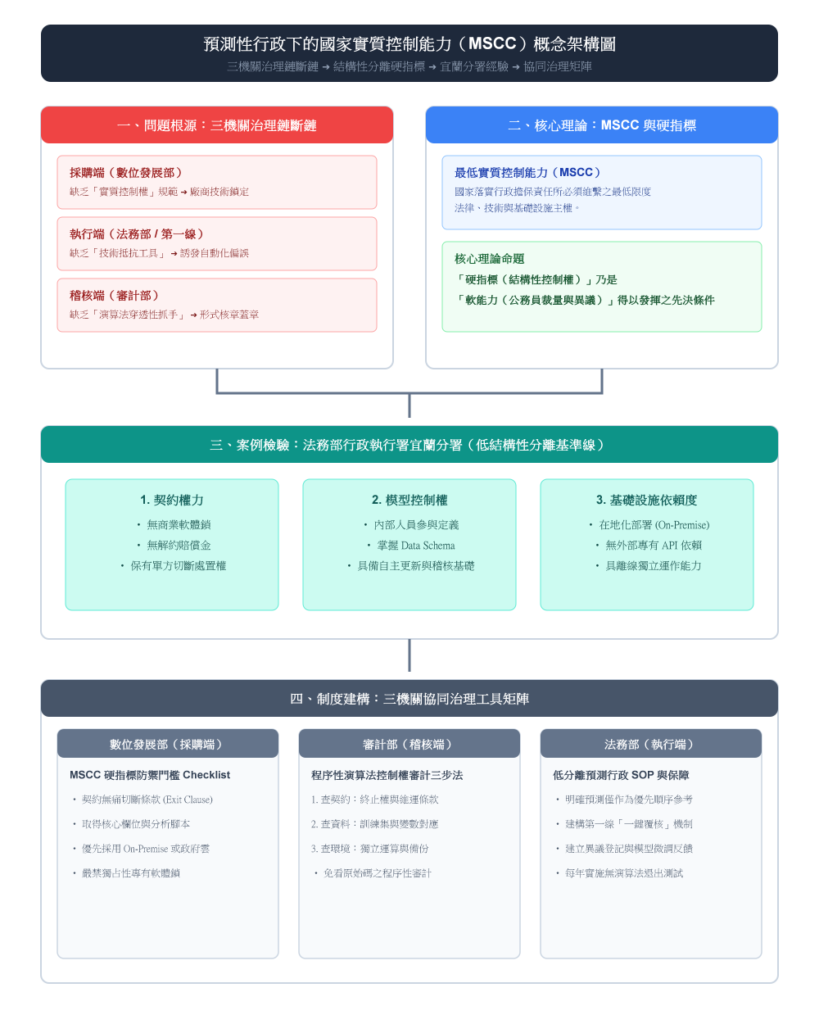
022—預測性行政下的國家實質控制能力:以宜蘭分署清償率模型檢驗結構性分離硬指標 (2026)(閱讀對應評語)
摘要
隨著生成式 AI 與預測性演算法進入公務體系,行政機關對外部技術供應商的依賴程度日益加深。既有文獻多聚焦於「演算法黑盒(Black Box)」對可解釋性、正當法律程序與行政裁量權之威脅,主張透過「軟能力建構」(如公務員技術能力提升與內部反思能力)來維繫官僚自主性。然而,此類主張往往忽視了我國現行體制下「數位發展部(採購標準)—第一線執法機關(如法務部)—審計部(事後監督)」三方橫向斷鏈的深層落差。若在「採購與基礎設施」層面,國家已將核心運算能力、資料權屬與系統維運權實質讓渡給私法人,致使「結構性分離(Structural Separation)」不可逆轉,則要求第一線公務員憑一己之力抵抗演算法偏誤無異於緣木求魚。
本文採取 Desk-based 文件分析與案例研究法,以法務部行政執行署宜蘭分署(以下簡稱宜蘭分署)發展之「清償率預測模型」為研究對象,檢驗公機關在未進行高額資通訊外包的前提下,能否透過自主發展或高度對等之陪伴式開發,建立「最低實質控制能力」(Minimum Substantive Control Capacity, MSCC)。公開資料顯示,宜蘭分署個案在(1)契約權力與單方處置能力、(2)模型控制權與再訓練能力、以及(3)基礎設施依賴度等三項硬指標上,均呈現「傾向低結構性分離」之特徵,可作為後續研究之低分離基準線參照;惟此一判定嚴格限於公開資料可驗證之範圍,並非積極證明機關已完整取得技術主權。
本研究之理論貢獻在於,釐清了「硬指標(結構性控制權)」乃是「軟能力(公務員異議與裁量能力)」得以發揮的先決條件。據此,本文打破既有資策會科法所與傳統法學偏重單點倫理宣示之範式,針對數發部、審計部與法務部提出「採購門檻 Checklist、程序性稽核三步法、低分離 SOP」之三機關協同治理工具矩陣,為預測性行政下的國家行政擔保責任提供具體可操作之制度藍圖。為提升未來研究之可比較性,本文另於附錄一提出 MSCC 硬指標量化評分建議。
關鍵字:預測性行政、結構性分離、最低實質控制能力(MSCC)、技術鎖定、行政擔保責任、三方治理鏈、宜蘭分署
022e—The State’s Substantive Control Capability under Predictive Administration: Examining Hard Indicators of Structural Separation through the Yilan Branch’s Debt-Repayment-Rate Prediction Model (2026)
Abstract
As generative AI and predictive algorithms enter the civil service, administrative agencies have become increasingly dependent on external technology vendors. The existing literature has focused largely on the threat that the algorithmic “black box” poses to explainability, due process of law, and administrative discretion, advocating “soft-capacity building” — such as strengthening civil servants’ technical competence and internal reflective capacity — as the means of preserving bureaucratic autonomy. Such arguments, however, often overlook a deeper gap in Taiwan’s current institutional design: the lateral disconnection among the three agencies of “Ministry of Digital Affairs (procurement standards) — frontline enforcement agencies (such as the Ministry of Justice) — National Audit Office (ex post oversight).” If, at the level of “procurement and infrastructure,” the state has already substantively ceded core computing capacity, data ownership, and system-operation rights to a private legal entity, rendering “structural separation” irreversible, then expecting frontline civil servants to resist algorithmic bias through individual effort alone is a fool’s errand.
This paper adopts a desk-based document-analysis and case-study approach, taking the “debt-repayment-rate prediction model” developed by the Yilan Branch of the Ministry of Justice’s Administrative Enforcement Agency (hereafter, the Yilan Branch) as its research object, to examine whether a public agency — absent large-scale IT outsourcing — can establish a “Minimum Substantive Control Capacity” (MSCC) through self-directed development or a highly collaborative, mentorship-based development model. Public records indicate that the Yilan Branch case exhibits a “tendency toward low structural separation” across all three hard indicators: (1) contractual power and unilateral disposition capacity, (2) model control and retraining capacity, and (3) infrastructure dependency — and can therefore serve as a low-separation baseline for subsequent research. This determination, however, is strictly bounded by what can be verified from public data, and does not affirmatively prove that the agency has achieved complete technological sovereignty.
The theoretical contribution of this study lies in clarifying that “hard indicators” (structural control rights) are the precondition for “soft capacity” (civil servants’ capacity for objection and discretion) to be exercised at all. On this basis, this paper departs from the paradigm long favored by the STLI and traditional legal scholarship — which emphasizes isolated, declaratory ethical pronouncements — and instead proposes, for the Ministry of Digital Affairs, the National Audit Office, and the Ministry of Justice, a tri-agency collaborative-governance tool matrix comprising a “procurement threshold checklist,” a “three-step procedural audit method,” and a “low-separation SOP,” providing a concrete, operable institutional blueprint for the state’s administrative guarantee responsibility under predictive administration. To improve the comparability of future research, this paper further proposes, in Appendix 1, a quantitative scoring method for the MSCC hard indicators.
Keywords: predictive administration, structural separation, Minimum Substantive Control Capability (MSCC), technical lock-in, administrative guarantee responsibility, tri-party governance chain, Yilan Branch
023—破除軟法幻覺,建構公部門 AI 治理之最低實質控制能力(MSCC)——三機關落地工具矩陣與政策建議書(2026)(閱讀對應評語)
摘要
本研究旨在回應生成式人工智慧(Generative AI)與檢索增強生成(Retrieval-Augmented Generation, RAG)技術導入公部門後所引發的深層治理危機。過去數年,我國以財團法人資訊工業策進會科技法律研究所(資策會科法所)為代表的「軟法治理模式」,試圖透過自我合規檢核表與宣示性倫理指引約束演算法;然而,本研究指明此模式已陷入不可調和的「三重體制枷鎖」——受託法人的「業主邊界」、依賴資訊服務業者的「廠商包袱」,以及提供行政機關去責任化避風港的「官僚舒適圈」。在技術機理層面,生成式 AI 引發了國家行政權力的「高結構性分離」,包含底層算力設施外包、語意機率生成幻覺、RAG 向量切片密室,以及誘發自動化偏誤的「責任蒸發鏈」。
為破解此一憲政與行政法理困局,本研究提出「最低實質控制能力」(Minimum Substantive Control Capability, MSCC)作為公部門 AI 治理的硬法核定標準,並具體化為四大硬指標:零資料留存(ZDR)之資料履歷、單向斷路權(Kill-Switch)、切片級語意強歸因與全歷程 Log 稽核。本研究進一步建構三機關落地工具矩陣——數位發展部(MODA)政府採購 AI 契約標準範本、國家審計部全歷程數位稽核清單,以及行政法院實質審查與舉證責任反轉標準,補足了公共行政與公法學界在面對黑盒演算法時缺乏可營運、可裁罰監督工具的理論空白。
關鍵字:生成式 AI、軟法治理、最低實質控制能力(MSCC)、零資料留存(ZDR)、責任蒸發鏈
議題 03|資訊社會、數位民主與資訊治理
003—深偽何時成為國家治理事件?危害分級、暫時主責與治理審計——一項公共行政事件壓力測試(2026)(閱讀對應評語)
摘要
公共深偽最難處理的時刻,不在真相已經查明之後,而在真偽尚未確定、危害卻可能先一步擴大之時。國家元首、政府機關或高階官員遭AI冒用,起初可能只是諷刺、冒名或詐欺;然而,一旦訊息引起公共恐慌、干擾制度運作,或帶有境外操弄與國家安全風險,原有的單一機關分工便未必足以接住事件。本文不依深偽技術本身指定主管機關,而依危害類型、證據可信度、制度穿透程度與預期後果分級。本文預設政府機關依其職掌,已有通報規範、應變計畫、作業手冊或內部指引;問題在於,這些制度能否在事件尚未定性時彼此銜接。為此,本文以公共深偽事件壓力測試AI治理下的共同母架構(盧建旭,2026):二十五治理座標顯示事件如何跨座標移動;四條治理鏈追問情境由誰界定、誰有權決定、介入理由是否充分,以及錯誤或延誤由誰承擔;七項治理審計則保留事後可以查核的紀錄。全球文獻定位顯示,國際倫理與平台規範多集中於1×5至3×5,技術偵測及事件指引集中於5×3;較少被直接處理的是2×3,也就是政府組織之間的暫時主責、跨機關協調與升級條件。本文主要提供國安、調查、資安、國防及行政院體系中,負責情勢研判、政策分析與跨機關協調的研究員和中階行政官員使用。相同的壓力測試問題,日後亦可依不同法制與專業程序,調整後應用於國防、救災及緊急救護等高風險行政場域。
關鍵詞:公共深偽、AI冒名、危害分級、跨機關應變、二十五治理座標、治理鏈
003e—When Does a Deepfake Become a State Governance Incident? Harm Classification, Temporary Lead Responsibility, and Governance Audits: A Public Administration Incident Stress Test (2026)
Abstract
The most critical friction point in a public deepfake incident occurs before authenticity and legal classification are established—a period during which potential real-world harm can rapidly escalate. The AI-enabled impersonation of a head of state, public agency, or senior official may represent harmless satire, personal identity abuse, or fraud; equally, it may trigger public panic, institutional disruption, foreign information operations, or severe national security threats.
This paper establishes a framework to classify incidents by harm type, evidentiary confidence, institutional penetration, and anticipated impact. Assuming that public agencies already maintain baseline notification protocols, contingency plans, and internal operational guidance, the core problem is structural: how do these siloed mechanisms interface when an incident has not yet been classified?
Using a 25-cell governance matrix, this study maps cross-grid incident movements, uses four “governance chains” to evaluate context, authority, reasoning, and accountability, and provides seven ex-post governance audits to ensure procedural transparency. Existing literature largely concentrates on international norms and platform regulation (1×5 to 3×5) or technical detection mechanisms (5×3). This leaves a critical gap at cell 2×3: temporary lead responsibility, interagency coordination, and escalation triggers within public administration. The primary audience for this framework includes policy analysts and mid-level decision-makers in national security, law enforcement, cybersecurity, defense, and central executive coordination.
Keywords: public deepfakes; AI-enabled impersonation; harm classification; interagency response; governance coordinates; governance chains
006—AI 治理的民主正當性前置條件:情境建構權移轉、雙階段測量與跨案例示範 (2026)(閱讀對應評語)
摘要:
人工智慧進入公共行政後,民主正當性問題不只發生於正式行政決定作成之後,也可能發生於資料、分類、提示與閾值預先界定公共問題之時。若技術系統先行決定哪些事實可見、哪些群體被標記及哪些選項進入後續裁量,形式上的人類簽核未必足以恢復民主控制。本文承接盧建旭(2026)所提出之「二十五治理座標—三種行政權力功能性移轉—三項結構效應—四條治理鏈—七項治理審計」共同母架構,聚焦第一種權力移轉,即情境建構與事實認定權之功能性移轉,並主張其民主化是後續權威、理由與責任鏈取得正當性的前置條件。
本文校正既有測量設計,將「AI取得多少情境建構影響力」與「該影響力受到多少民主控制」區分為兩個不可互相替代的測量對象。第一階段以五項P1暴露指標評估權力移轉強度;第二階段以可追溯性、資料納入與排除、框定邏輯可重建性、民主檢視與可修正性四構面十二項C1指標,評估情境建構鏈完整度。計分採描述性聚合、資料涵蓋率與規範門檻並列,不以高平均分補償異議管道之缺失。本文再以AFST、SyRI與Robodebt進行公開文件型示範重編碼。結果顯示,三案皆存在中度以上的P1暴露,但民主正當性狀態不同:AFST具有較完整的技術文件與有限社群參與,惟正式框定異議管道之公開證據不足;SyRI與Robodebt則呈現高權力移轉、低C1完整度,且後續分別出現隱私權、理由與責任鏈之重大斷裂。本文提供的是可重複檢驗的測量藍圖與示範編碼,尚非完成信效度驗證的正式量表。
關鍵詞:AI治理、民主正當性、情境建構鏈、權力移轉、形成性測量、演算法行政
006e—Democratic Preconditions for AI Governance: Transfer of Situation-Construction Power, Two-Stage Measurement, and Cross-Case Illustration (2026)
Abstract:
The democratic legitimacy of artificial intelligence in public administration may be compromised before a formal administrative decision is made. Data selection, classification, prompts, and thresholds can pre-structure which facts are visible, which groups are marked, and which options enter later discretion. Formal human sign-off does not necessarily restore democratic control when the technical framing has already narrowed what decision-makers can see.
This paper develops the P1–C1 measurement blueprint within the shared 25-3-3-4-7 framework: twenty-five governance coordinates, three functional transfers of administrative power, three structural effects, four governance chains, and seven governance audits. It concentrates on P1—the functional transfer of situation-construction and fact-recognition power—and treats the context-construction chain as the democratic precondition for subsequent authority, reasoning, and responsibility.
The design separates two non-substitutable objects of measurement. Stage 1 uses five P1 exposure indicators to assess how strongly AI shapes the construction of a public problem. Stage 2 uses twelve C1 indicators across four dimensions—traceability, inclusion and exclusion of data, reconstructability of framing logic, and democratic review and correction—to assess the integrity of the context-construction chain. Descriptive aggregation, coverage rates, and normative thresholds are reported side by side; a high mean may not compensate for the absence of a channel through which framing can be contested. Demonstration recoding of AFST, SyRI, and Robodebt shows that all three cases combine substantial exposure with material deficits in democratic integrity.
Keywords: AI governance; democratic legitimacy; context-construction chain; power transfer; formative measurement; algorithmic administration
007—AI 治理下政策體系的情境建構鏈延伸:議題判斷—政策規劃—政策制訂—政策執行—政策評估—政策回饋–六階段重編碼與制度因應(2026)(閱讀對應評語)
摘要:
人工智慧進入公共治理後,其影響不僅發生於個案裁量,也可能沿政策體系的完整循環擴散、疊加並自我強化。本文延伸既有之「二十五治理座標—三種行政權力功能性移轉—三項結構效應—四條治理鏈—七項治理稽核」共同母架構,將分析單位由單一情境建構鏈擴展至議題判斷、政策規劃、政策制訂、政策執行、政策評估與政策回饋六階段。加入政策執行並非增加新的治理座標,而是補足正式方案轉化為資格認定、資源配置、管制與服務提供的關鍵節點;P3公權力決定之實質影響力、責任分配與救濟需求,正是在此具體化。本文提出政策體系版雙階段測量雛形——政策權力移轉暴露(PE)與政策正當性完整度(PI)——並將七項治理稽核定位為壓力測試工具。概念性案例嚴格區分可觀察證據、假設情境與資料不足(NA),不再對異質案例計算合成平均。本文並依2026年8月可得之官方資料,更新台灣《人工智慧基本法》及其施行規劃、歐盟AI法最新修正、歐洲理事會AI框架公約與韓國AI基本法。本文仍屬概念建構與工具雛形,尚未完成正式雙人編碼與信效度檢驗。
關鍵詞:AI治理、政策循環、情境建構鏈、民主正當性、政策階段論、演算法行政
007e—Extending the Situation-Construction Chain into the Policy System: A Six-Stage Reframing of Agenda Setting, Planning, Formulation, Implementation, Evaluation, and Feedback under AI Governance (2026)
Abstract:
The democratic-legitimacy risks of artificial intelligence in public administration may propagate across the full policy cycle. This article extends the 25-3-3-4-7 framework—twenty-five governance coordinates, three functional transfers of administrative power, three structural effects, four governance chains, and seven governance audits—into six stages: agenda setting, policy planning, policy formulation, implementation, evaluation, and feedback. Treating implementation as a distinct stage does not add a coordinate; it identifies the point at which formal policy becomes eligibility decisions, resource allocation, regulation, and service delivery. It is therefore where P3, responsibility diffusion, and concrete rights effects frequently emerge.
The article develops a two-stage policy-system measurement blueprint. Stage 1 records Policy-system Exposure (PE) across six stage-specific indicators. Stage 2 evaluates Policy-system Integrity (PI) through traceability of public reasoning, verifiability of data and target groups, reconstructability of framing and ranking logic, and democratic review and correction. The design rejects cross-stage compensation: a strong later-stage score cannot repair a prior-stage exclusion that has already structured what policy can see. Bounded demonstrations using Join, TAIDE, AFST, Robodebt, and SyRI show how evidence can locate a system without manufacturing a false longitudinal causal story.
Keywords: AI governance; policy cycle; context-construction chain; democratic legitimacy; policy stages; algorithmic administration
036–資訊社會中公共行政的新議題:三十年後的重訪(1996-2026)——一篇跨世代的重新檢視 (2026) (閱讀對應評語)
摘要
三十年前,Cleveland(1985)曾以五項臆測,描繪資訊社會將如何重組公共行政的權力層級;筆者當年據此呼籲學界正視資訊社會,卻未曾檢驗這些臆測本身是否成立。問題是:「資訊科技的擴散必然帶來去集中化與治理民主化」這項技術決定論式的命題,禁得起三十年的實務檢驗嗎?本文重訪1996年〈資訊社會中公共行政的新議題〉一文,逐項檢視Cleveland五項臆測,發現僅一項——資訊公開——在制度形式上局部應驗,卻也衍生出演算法不透明的新兩難;其餘四項不僅未如預期實現,甚至朝相反方向發展:資訊擴散在特定市場與制度條件下促成平台權力集中,而非預期中的參與式權力;資訊不易獨佔的特性,並未使所有權觀念過時,反而使個人、企業與國家三方的資料控制與使用權爭議顯著增加;地理鄰近性非但沒有消失,反而以晶片、資料中心與海纜的形式,使特定基礎設施的地理位置重新具有高度戰略意義。公共行政學界雖已從忽視資訊社會,轉向以「數位治理」(digital era governance)等典範積極回應,台灣學界也從1996年原文批評的「停留在工業社會思考層次」,走向政策與機構層面的積極跟進,但這是否代表整合缺口已經補上?本文的判斷是:尚未——研究數量的成長,掩蓋了不同研究次領域之間仍存在整合不足、彼此不充分對話的事實。基於此一診斷,本文提出2026年視角下的新議題,並以路徑圖形式,具體指出各項議題應由誰研究、誰負責、以何種時間尺度檢驗。
因此,本文所稱的「資訊公開」需區分文件公開、資料公開、決策過程公開、模型或程式公開、可理解的理由說明,以及受影響者的參與與申訴。透明並非單純增加資訊數量,而是使受影響者能夠理解、質疑並在制度允許的範圍內影響決策。
關鍵詞:資訊社會;公共行政;數位治理;演算法治理;制度中介
議題 04|公共行政、科技轉型與跨學科整合
008—AI治理下公共行政教育的知識落差與能力重構:以五項議題範圍與5×5知識座標為分析架構 (2026)(閱讀對應評語)
摘要
如果政府服務逐漸移至虛擬空間,行政決定不再全由第一線公務人員作成,福利資格、司法風險、預算配置與公共給付又由演算法形成建議甚至結果,公共行政教育面對的問題便不再是是否增設AI工具課,而是既有知識能否辨識並處理新型政府活動。本文將AI治理視為既定條件,以「二十五治理座標—三種行政權力功能性移轉—三項結構效應—四條治理鏈—七項治理審計」共同母架構,分析虛擬政府、無人政府/無人行政、AI行政裁量、AI司法與準司法判斷,以及AI財政、信用點數與可程式化給付五項議題範圍,辨識公共行政教育之變與不變。分析依辨識、討論、辯證、印證與建議五階段展開:先以25座標定位議題,再以情境建構與事實認定、行政裁量與價值判斷、公權力決定之實質影響力三種功能性移轉,解釋跨座標移動、邊界消解與權威重構如何發生;四條治理鏈與七項治理審計則作為課程應能理解的治理內容,而不另行建立治理量表。研究顯示,五項議題均由單一技術或管理格位向政策、制度及其他分析單位移動;就本文所檢視之課程與訓練文件而言,AI內容已進入正式結構,但現有證據較能證明明示涵蓋與工具應用,跨層次整合及真實問題應用轉移仍顯不足。公共行政教育改革因此不是以技術取代行政學,而是保留知識骨架,重組課程內容、跨域連結與應用教學。
關鍵詞:AI治理、公共行政教育、知識座標、跨域教育、能力重構
008e—Knowledge Gaps and Capability Reconstruction in Public Administration Education under AI Governance: Five Issue Domains and a 5 × 5 Knowledge-Coordinate Framework (2026)
Abstract:
As government services move into virtual space and algorithmic systems increasingly shape welfare eligibility, judicial risk, budget allocation, and public benefits, the question for public-administration education is no longer whether to add an AI tools course. It is whether its existing knowledge can recognize and govern new forms of public activity. This article treats AI governance as a standing condition and uses the shared 25-3-3-4-7 framework to analyse virtual government, unmanned government and administration, AI-assisted discretion, AI judicial and quasi-judicial judgment, and AI-mediated fiscal allocation, credit scoring, and programmable benefits.
The article develops a 5 × 5 knowledge-coordinate framework and uses preliminary document-based evidence to identify where education falls short. Its central finding is that the knowledge architecture of public administration remains necessary, but the content of each coordinate, the relations among courses, and the division of labor between public administration and information technology require reconstruction. The most serious gap lies not in whether AI is mentioned, but in interdisciplinary integration and the transfer of learning into real institutional problems.
Keywords: AI governance; public administration education; knowledge coordinates; interdisciplinary education; capability reconstruction
015—翻轉工具論:AI治理下的大學公共行政課程規劃——從權力移轉辨識到治理稽核能力的階梯式課程藍圖 (2026)(閱讀對應評語)
摘要
本文主張,公共行政教育若僅將人工智慧(AI)定位為提示詞、文書摘要或資料處理工具,將無法回應其對行政事實、裁量與公權力效果的實質重構。本文以「25—3—3—4—7」母架構為分析工具,提出一套由學士班至博士班的階梯式課程藍圖。該藍圖依序培養學生的二十五治理座標定位、P1情境建構與事實認定權移轉、P2行政裁量與價值判斷權移轉、P3公權力決定實質影響,以及四條治理鏈與七項治理稽核能力。本文採概念建構、文獻分析與臺灣規範文件的探索性診斷,不將零星課程或研習推論為全國性統計結論。其貢獻在於把AI素養從技術操作,轉為可觀察、可教學、可評量的公共治理能力。
關鍵詞:人工智慧治理、公共行政教育、行政裁量、演算法課責、課程規劃、治理稽核
015e—Reframing Instrumentalism: Curriculum Planning for Public Administration in the Age of AI Governance—From Power Transfer Identification to a Scaffolded Blueprint for Governance Auditing Capability (2026)
Abstract
This article argues that if public administration education merely positions artificial intelligence (AI) as a tool for prompt engineering, document summarization, or data processing, it will fail to address AI’s substantive reconfiguration of administrative facts, discretion, and public power effects. Drawing on the “25-3-3-4-7” meta-framework as an analytical instrument, this paper proposes a scaffolded curriculum blueprint spanning bachelor’s to doctoral levels. The blueprint sequentially cultivates students’ capacity for (a) 25-governance-coordinate positioning, (b) P1 transfer of context construction and fact-finding authority, (c) P2 transfer of administrative discretion and value judgment, (d) P3 substantive impact on public power decisions, and (e) four governance chains and seven governance audit capabilities. Adopting conceptual construction, literature analysis, and exploratory diagnosis of Taiwanese regulatory documents, this study does not extrapolate isolated courses or workshops into national statistical conclusions. Its contribution lies in transforming AI literacy from technical operation into an observable, teachable, and assessable public governance competency.
Keywords: AI governance, public administration education, administrative discretion, algorithmic accountability, curriculum design, governance audit
020—我們累積的是AI治理研究,還是AI治理知識?—臺灣研究的全球比較與理論壓力測試 (2026)(閱讀對應評語)
摘要
人工智慧進入政府,早已不是單純的資訊系統導入。當演算法開始參與問題如何被界定、資格如何被認定、甚至權利義務如何被決定時,真正被改變的不是工具,而是行政權力本身。
這幾年,相關研究確實快速增加。臺灣在公共行政、數位治理、法律與公共政策領域也累積了不少成果,從公共價值、倫理風險、行政裁量,到資料治理、演算法解釋權,幾乎都有人觸及。問題是,研究變多了,是否就代表我們已經形成一套可以被後續研究持續定位、連結、比較與檢驗的治理知識?這是兩個不同層次的問題。
本文採取 Overview–Comparative–Test(OCT)策略。先分別整理全球與臺灣 AI 治理研究的主要累積,再比較兩者知識碎片化的型態差異,最後以 25 治理座標、三種權力功能(P1 情境建構、P2 行政裁量、P3 公權力影響)、三項結構效應、四條治理鏈與七項治理審計作為受測架構,進行反證式的理論壓力測試。判準有二:Coverage Failure(CF)指重要現象無法被合理涵蓋,Added-Value Failure(AVF)指架構雖能重新描述既有研究,卻未增加實質分析價值。
結果顯示,全球與臺灣都不缺重要問題,也不缺治理處方。擴大至跨學科、制度與實務材料後,更可確認全球並非沒有架構,而是出現系統性回顧、多層治理模型、風險管理框架、管理系統標準、制度監理工具等大量並存的局面。全球較適合描述為「垂直與水平碎片化下的架構繁衍,但跨架構整合仍不完整」;臺灣則基於本文檢視的擴大樣本,呈現「議題持續深化、個別架構分散形成,但跨研究收斂仍有限」。擴大測試後,本文未辨識出確認的 CF,整體 25–3–3–4–7 亦未出現足以要求重構的 AVF,但部分構件的原創性主張確實被削弱:3E 不宜再被理解為三種全新現象,而應定位為整合性的結構診斷程序;七項治理審計若主張為獨立理論創新,面對 NIST AI RMF、ISO/IEC 42001、加拿大 AIA 等成熟工具時會構成 AVF,因此本文將其降格為承接前端公共行政分析結果的操作性審計介面。本文據此給予 25–3–3–4–7「經修正後的暫時支持」,而非原樣存活或永久證明。
關鍵詞:AI治理、公共行政、知識累積、知識碎片化、治理座標、行政裁量、理論壓力測試、反證式測試、臺灣
020e—Are We Accumulating AI Governance Research—or AI Governance Knowledge?—A Global Comparison and Theoretical Stress Test of Research in Taiwan (2026)
Abstract
Research on artificial intelligence in government has expanded rapidly. In Taiwan, public administration, digital governance, law, and public policy scholarship has addressed public values, ethical risks, administrative discretion, automation bias, organizational change, institutional design, regulatory adaptation, public services, civil-service capacity, data governance, and the right to explanation. Yet an increase in research output does not necessarily mean that a field has accumulated governance knowledge that can be continuously located, connected, compared, and tested.
This article adopts an Overview–Comparative–Test (OCT) strategy. It reviews major accumulations in global and Taiwanese AI governance research and compares their patterns of knowledge fragmentation. It then subjects the 25–3–3–4–7 framework to a falsification-oriented theoretical stress test using Coverage Failure (CF) and Added-Value Failure (AVF) as failure criteria. Based on the expanded Taiwanese sample examined in this article (covering public administration, data governance, fairness/rights, institutional design, local government, and generative AI clusters), Taiwan exhibits substantive deepening with dispersed framework formation but limited cross-study analytical convergence. The global literature is better characterized by framework proliferation under vertical and horizontal fragmentation with incomplete cross-framework integration.
The expanded challenge set does not identify a confirmed CF or an AVF requiring reconstruction of the framework as a whole, but it does materially revise the status of several components. The three structural effects (3E) are retained as an integrative structural diagnostic procedure rather than as three wholly novel phenomena. The seven governance audits, when treated as an independent theoretical innovation, face AVF in light of mature instruments such as the NIST AI RMF, ISO/IEC 42001, and Canada’s Algorithmic Impact Assessment; they are therefore repositioned as an operational audit interface that translates upstream public-administration analysis into implementable governance checks. The resulting conclusion is revised provisional support, not proof of universal validity.
Keywords: AI governance; public administration; knowledge accumulation; knowledge fragmentation; governance coordinates; administrative discretion; theoretical stress test; falsification test; Taiwan
021—公共行政學如何吸收技術變遷:典範文獻、壓力測試與未吸收的異常 (2026)(閱讀對應評語)
摘要
公共行政學一直是靠層級節制、契約、組織重組與人類監督,把技術複雜性收編進既有的控制架構裡。本文系統回顧三個主要行政典範—古典公共行政、新公共管理(NPM)、數位時代治理(Digital-Era Governance, DEG)——加上當代演算法治理研究,看它們怎麼處理技術、外包、數位系統與演算法進入行政體系這件事。分析顯示:這些理論全都預設「公法責任位置」和「實質控制位置」本來就該重合,就算分開了,也能靠治理工具重新對齊。本文對這四套文獻做同一套壓力測試:當兩個位置結構性分離時,既有機制真的能讓公共權威恢復實質控制嗎?結果是:不能,頂多修一半。每一套理論都只能提供部分修復,沒有一套講清楚實質控制要恢復到什麼程度才算數。當前的治理困境,不是演算法黑箱造成的技術問題,而是制度設計本身的「權威與能力斷裂」——公法體系要求政府對行政處分負最終責任,但技術運作的實質控制權早已下沉、鎖進外部的演算法基礎設施裡。本文因此定位兩個由未吸收異常所逼出的理論缺口,但不提出解答。
關鍵詞:公共行政典範、新公共管理、數位時代治理、演算法治理、公法責任、責任位置、控制位置、結構性分離、實質控制、理論異常
021e—How Public Administration Absorbs Technological Change: Paradigm Literature, Stress Testing, and the Unabsorbed Anomaly(2026)
Abstract
Public administration has always absorbed technological complexity into its existing control architecture through hierarchy, contracts, organizational restructuring, and human oversight. This paper systematically reviews three major paradigms of public administration—classical public administration, New Public Management (NPM), and Digital-Era Governance (DEG)—together with the contemporary field of algorithmic governance research, to examine how each has handled the entry of technology, outsourcing, digital systems, and algorithms into the administrative apparatus. The analysis shows that all of these theories assume the locus of public-law responsibility and the locus of substantive control are inherently meant to coincide, or that governance tools can realign them once they diverge. This paper subjects all four bodies of literature to the same stress test: when the two loci become structurally separated, can existing mechanisms restore substantive control to public authority? The answer is no—at best, they achieve partial repair. Each theory offers only partial remedies, and none specifies the threshold at which substantive control can actually be considered restored. The current governance predicament is not a technical problem created by algorithmic black boxes; it is an “authority–capacity rupture” built into institutional design itself—public law requires government to bear ultimate responsibility for administrative dispositions, even as the substantive capacity to control how the technology actually operates has already settled into, and become locked within, external algorithmic infrastructure. This paper therefore locates two theoretical gaps forced open by this unabsorbed anomaly, without proposing a solution.
Keywords: paradigms of public administration, New Public Management, Digital-Era Governance, algorithmic governance, public-law responsibility, locus of responsibility, locus of control, structural separation, substantive control, theoretical anomaly
議題 05|制度誘因、行政行動與公共判斷
024–AI治理下文官薪酬與考核制度具體化:數位治理職能加給分級設計與治理審計導向考核權重公式 (2026)(閱讀對應評語)
摘要
第014篇指出AI鑲嵌公共行政後,官僚組織之薪酬與考核制度面臨結構性壓力測試,並提出「雙軌文官」與「治理審計導向KPI」作為方向性回應,惟具體加給額度與考績權重須留待後續發展。本文以此為起點,透過比較英國DDaT能力框架與Pay Framework Allowance(PFA)、新加坡法定機構市場薪酬邏輯(概念性對照),以及我國資安人才待遇改革先例,將方向性主張轉譯為可操作之制度設計方案。
本文主張「數位治理職能加給」應定位為技能薪/職能薪(skill-based / competency-based pay)而非績效薪,以避免效率導向誘因重演治理風險。其次提出Level 0至Level 3四級職能分級,並附可驗證能力規準;加給比例以低/中/高三種情境方案呈現,屬示意設計而非實證推導結論。第三,將治理審計導向KPI轉換為可加總量化考核公式,並設計三層次「安全港」(Safe Harbor):考核保障、加給保障,以及法律責任仍依一般行政法與懲戒法認定。職位綁定式退場機制用以防止加給既得利益化。
本文對照公開可得之政策文件與報導(含「AI公務人才認定指引」試行相關資訊、考績法修正草案動態、人工智慧基本法相關進展),確認「AI能力認證如何轉換為加給與考核」仍屬政策空白。所有數字與條文草案均屬規範性方案,其精確校準與法律效果有賴人事主管機關協商、正式法律審查與試辦驗證。本文定位為政策設計型研究,非已完成之實證或立法結論。
關鍵詞:AI治理;文官薪酬;數位治理職能加給;治理審計;考核權重;雙軌文官;比較文官制度;安全港
025—AI鑲嵌式公共行政的東亞制度壓力測試:台灣、日本與韓國政策場域群的制度診斷 (2026)(閱讀對應評語)
摘要
既有AI公共行政文獻高度依賴西方經典案例(SyRI,NJCM et al. v. The Dutch State, 2020;Robodebt,Royal Commission into the Robodebt Scheme, 2023;PredPol),多聚焦於人工裁量移除、責任稀釋或程序正義直接侵害(Bovens & Zouridis, 2002; Young et al., 2019)。本文以台灣、日本、韓國三個異質政策場域為壓力測試對象,檢驗第014篇25-3-3-4-7架構的解釋力,並延伸探討緊急治理情境與快速部署需求下的程序張力。
核心命題:AI行政的制度風險,未必表現為程序與人工裁量的直接消失,而可能表現為形式保障持續存在、實質治理功能卻逐步弱化。本文將此現象概念化為「形式保障與實質治理功能脫鉤」,並在所分析的政策場域中辨識三種表現型態:形式合法/實質黑箱、人工形式保留/判斷功能弱化、緊急治理下的程序壓縮。三者可能在特定條件下形成「認知安全緊急性 → 責任避險 → 形式合法/實質黑箱」的強化循環,但此循環目前定位為可檢驗的分析命題與理想型模型,而非已獲實證的單一因果鏈。
研究設計明確定位為「異質政策場域的概念複現與機制辨識」,而非嚴格相似系統跨國比較。分析單位為政策場域/制度情境,而非國家本身。資料以2020–2026年已公開官方文件為主,並嚴格區分【文件證據】、【制度推論】與【規範判斷】,以及證據強度分級。本文不主張三國制度同質。據此提出成文法合致性審計矩陣、善意異議責任安全港、限定範圍第二意見程序、非對稱簡化紀錄,以及風險分級失效條款等規範性設計規格。結論屬初步類型辨識與探索性概念研究。
關鍵字:演算法治理;形式—實質脫鉤;責任避險;緊急治理;街頭官僚;系統層級官僚;東亞公共行政;制度設計
026—形式保障與實質治理功能脫鉤的機制與條件 : 從東亞政策場域到跨制度比較假說的建構——承接第025篇核心發現之中層機制理論 (2026)(閱讀對應評語)
摘要
本文探討人工智慧嵌入公共行政後,形式程序保障與實質治理功能可能產生脫鉤的制度機制。不同於既有制度學派脫鉤理論側重組織對外部合法性壓力的回應,本文提出「防禦性脫鉤」概念,聚焦第一線文官將形式合規轉化為個人責任防禦機制的過程。防禦性脫鉤並非單純的避責行為,亦非單純的自動化偏誤,而是兩者透過行政程序制度化後所形成的形式—實質落差。
本文區分避責驅動(路徑A)與預設錨定(路徑B)兩條互補路徑,並建立多層次分析框架:組織層次的咎責結構透過影響個人對偏離成本的知覺,進一步提高形式合規與AI依賴行為。兩條路徑在行政處分的「事實認定」與「效果裁量」階段可能呈現不同主導邏輯。本文提出程序密度、異議保護、外部審計與任務情境的條件假說,並規劃公文文本分析、文官情境實驗及深度訪談的三階段實證策略。
本文主張,AI治理不應停留於「有人簽核」的形式要求,而應同時建立具備資訊、權限、能力、時間與責任保護的實質監督制度。在高專業認同、具備偏離權限且組織能承擔錯誤責任的環境中,程序密度未必導致防禦性脫鉤——此為本文理論的重要邊界條件。
關鍵字:演算法治理;人為最終控制;防禦性脫鉤;避責理論;預設錨定;街頭官僚;街頭演算法;臺灣行政法
027—誰在行政行動?人工智慧時代行政行動者概念的理論重構 (2026)(閱讀對應評語)
【論文定位】純理論推演。透過概念分析、隱含前提辨識與規範/本體論推演形成新的理論命題。案例僅作說明性直覺範例,不作為驗證架構的主要方法。核心概念:分散式行政行動(Distributed Administrative Action)、行政行動生成的四層構成。與028「裁量場」、029「公共判斷不可外包原則」共同構成AI時代公共行政理論三部曲。
摘要
公共行政學對行政行動的理解,長期在法律歸屬、規範意志與責任承擔上,傾向保留人類或由人類組成的組織作為最終行動主體。本文並非主張傳統行政學完全忽略組織與制度,而是指出:傳統理論雖已處理多重條件,但在規範意志與法律責任的最終歸屬上,仍傾向保留人類或人類組織作為不可化約的終點,本文稱此為「最終人類主體預設」。當資料選擇、模型計算、介面設計與組織程序共同參與行政結果的生成時,若繼續僅以最終簽核的人類或機關作為唯一分析焦點,將難以充分解釋權力實際如何運作。本文主張,人工智慧時代的行政行動,應由「最終人類主體預設」轉向「分散式行政行動」(Distributed Administrative Action),並提出「行政行動生成的四層構成」(法定行動者、判斷行動者、計算性作用者、結構性作用者)作為分析框架,其中計算層次進一步區分規範裁量、設計裁量與運算選擇三種性質不同的判斷,以釐清AI通常承載或放大設計裁量、而非自行擁有完整規範裁量。本文以一項社會福利資格審查的分析性示例,展示四層構成如何具體應用於個案分析。本文同時堅持一項理論邊界:參與行政行動不等於取得公共權威,計算與結構層次可具因果影響,但不能成為公共權威的終點。本文主動回應工具論、組織論與法律歸屬論三種競爭性理論,並區分責任來源的分散、責任承擔的配置與責任的稀釋,以避免「分散式課責」淪為責任落空。
關鍵詞:分散式行政行動;行政行動者;行政裁量;演算法官僚;分散式課責;多手問題;人工智慧治理
028—裁量何在?人工智慧時代行政裁量的轉移、分散與再制度化 (2026)(閱讀對應評語)
【論文定位】純理論推演。不問「AI是否取代人類裁量」,而是理論推演裁量概念的本體轉向——從個體心理之「決策點」轉化為跨系統之「裁量場」。本文所稱四個核心節點並非封閉、窮盡的分類,而是分析裁量分布的理想型架構;下文案例為說明性分析案例,非實證研究。核心概念與027「分散式行政行動」、029「公共判斷不可外包原則」形成理論呼應。
摘要
本文探討人工智慧導入行政決策後,行政裁量是否消失,以及裁量應如何重新定位。既有討論常陷入「裁量消失論」與「最後核章論」的二元對立,本文指出兩者其實共享同一隱含前提——裁量必須集中於某個可識別的「決策點」。本文主張,AI時代的裁量並未消失,而是分布於資料、模型、介面與覆核等相互連結的制度技術節點;核心問題應從「裁量還在不在」轉向「裁量何在、如何分布、如何重新變得可見」。為避免將所有具選擇性的技術或組織行為都籠統稱為「裁量」,本文提出三層區分——法律層次(行政裁量權)、制度層次(政策裁量)、技術層次(裁量性配置)——並主張:技術與制度配置構成或塑造法律裁量的前提條件,而非直接等同於法律裁量本身。本文以「四個核心節點」(前置、模型、介面、覆核)描述裁量性配置的分布位置,並輔以一項稅務稽核案件排序的分析性示例,展示各節點如何具體影響行政結果。本文進一步將「裁量可見性」拆解為來源、規則、過程、理由、責任五個可操作面向,並區分技術透明、程序透明、責任透明與救濟可用性。最後,本文將主命題收斂為三個可檢驗的子命題(位置命題、分布命題、課責命題),並提出八項最低制度要求,作為將「裁量場」由理論隱喻轉化為可操作分析與制度設計工具的具體路徑。
關鍵詞:行政裁量;裁量場;分布式裁量;裁量可見性;演算法治理;系統級官僚
029—不可外包的行政:人工智慧時代公共判斷的理論邊界 (2026)(閱讀對應評語)
純理論論文|規範論/權威邊界篇(完整擴寫・校正版)
【論文定位】純理論推演。從「能力限制/AI禁區清單」升級為「規範轉換條件」與「公共權威外部化」診斷,建立「公共判斷不可外包原則」。與027「分散式行政行動」、028「裁量場」形成完整理論閉環:生成可分散、裁量可分布,權威的最終再介入能力不可外包。案例僅作說明性分析,非實證驗證。
摘要
當人工智慧系統深度參與行政過程,傳統「任務可移轉、權威不可移轉」的外包前提開始出現規範斷裂。本文主張,真正的危機不在於AI「能不能做」,而在於行政組織可能逐步失去形成、修正與承擔公共判斷的制度能力,發生「公共權威外部化」(Externalization of Public Authority)。本文建立「規範轉換條件」,說明一項看似技術性的工作在何種條件下轉化為公共判斷;提出公共權威的四個不可完全移轉條件(價值、理由、例外、責任);並確立「公共判斷不可外包原則」——非劃定技術禁區,而是要求公共體系保有最終重新判斷、說明理由、承認例外與承擔責任的制度位置與實質能力。本文以一項庇護/難民風險初篩案例展示規範轉換條件如何具體判定,並主動回應人類中心主義、工具論與法律歸屬論三種反論,與027、028形成規範論封頂。
關鍵詞:公共權威外部化;公共判斷不可外包原則;規範轉換條件;行政外包;人工智慧治理
030—人工智慧時代公共行政之「生成—裁量—權威」理論架構:從分散式行政行動到公共權威的最終再介入能力 (2026)(閱讀對應評語)
摘要
本文整合「分散式行政行動」(Distributed Administrative Action, DAA)、「裁量場」(Field of Discretion)與「最終再介入能力」(Ultimate Capacity for Public Reintervention, UCPR),提出一套解釋人工智慧如何重構公共行政的中層理論架構。本文不再將 AI 視為單純工具,也不將行政結果還原為最終簽核者的個人意志,而是主張行政結果由法定位置、判斷位置、計算機制與結構條件共同生成。生成結構的分散,進一步使裁量由個案決策點轉移並分布於資料選擇、模型轉譯、介面引導與人類覆核等節點。為避免技術中介造成公共權威的實質外部化,公共機關必須保有理解、重新判斷、修正、否決、說明、承認例外與承擔責任的制度能力,即 UCPR。本文以荷蘭 SyRI(Systeem Risico Indicatie)福利詐欺偵測系統作為 UCPR 缺失的反面教材,並對照加拿大演算法影響評估(Algorithmic Impact Assessment, AIA)框架與歐盟《人工智慧法》(AI Act)高風險系統規範,說明制度工具如何維持公共再介入能力。本文並將組織設計、採購契約與資料分布偏移的動態更新機制納入同一治理模型。核心命題是:生成可以分散,但必須可追溯;裁量可以分布,但必須可見;權威可以被技術中介,但必須可再介入。
關鍵詞:分散式行政行動(DAA)、裁量場、最終再介入能力(UCPR)、演算法行政、公共權威、演算法影響評估(AIA)
031—電子圍籬作為分散式行政行動:以030模型初步檢視台灣COVID-19智慧監控系統之文件個案研究
摘要
研究目的:本文以臺灣COVID-19電子圍籬智慧監控系統(及其查證輔助工具雲龍系統)為個案,初步檢視作者提出之「030模型」(本體論—結構論—風險層—規範論四個分析構面,整合自027、028、029三篇理論演繹)在描述分散式行政行動與前置裁量配置上之概念適配性與分析可操作性。研究問題收斂為三:電子圍籬是否可描述為分散式行政行動?其裁量是否在正式行政處分作成前,已配置於資料範圍、技術參數與警示流程之中?現有行政監督與司法救濟,是否具備UCPR所要求之最終再介入能力?
方法與資料:本文採取文件個案研究策略,以監察院111社調0006號調查報告為主要官方資料,輔以林于婷(2022,國立政治大學法律學系碩士論文)之整理分析與張德威、黃雙翊(2022/2023)之獨立提審裁定統計,並以【E】文件明示、【E+I】文件明示並可作合理推論、【N】本文之規範性評價、【U】資料不足或尚未確認四種標記區分證據強度。
主要發現:電子圍籬之行政行動可定位於法定機關、第一線人員、定位系統與資料基礎設施四個層次;系統之資料範圍、定位門檻與警示流程,在正式查證前已對後續判斷產生篩選與排序效果,此等技術參數目前可確認具有行政效果,惟尚不足以確認其設定者及法律裁量性質;行政監督與司法救濟雖具制度外觀,但於資訊揭露、基礎處分審查範圍與課責銜接上,存在初步可辨識之落差。
研究限制與貢獻:本文為單一個案之文件研究,部分資料僅透過學術文獻整理轉引,編碼亦未經第二位研究者獨立比對,結論性質為「030模型概念適配性之初步文件檢視」,不宜解讀為對該模型之經驗驗證,亦不代表電子圍籬制度已被證明違法或違憲。
本文核心論旨可壓縮為三句:其一,電子圍籬並非單一機關直接完成之行政措施,而是由法律授權、行政機關、人員、定位系統與資料基礎設施共同構成的分散式行政行動;其二,文件可以確認資料納管、技術參數與警示流程在人工查證前已產生篩選與排序效果,但尚不能確認參數設定者、決策責任及其法律性質;其三,監察與司法救濟形式上存在,惟資訊取得、基礎處分審查及改善責任之間出現初步落差,此一結果支持UCPR作為風險辨識工具的概念適配性,但不足以證明UCPR在本案中已完全失效。
關鍵詞:分散式行政行動、行政裁量、演算法治理、電子圍籬、行政監督、司法救濟、COVID-19
議題 06|數位平台、國家治理與準公共基礎設施
037—從私人平台到準公共基礎設施:數位平台國家化治理的制度邊界
摘要
本文為銜接 036〈資訊社會中公共行政的新議題:三十年後的重訪〉之工作論文,將分析焦點由資訊社會總論縮小至外部市場平台,探討當 Google、Meta、LINE 等私人數位平台因市場集中、網絡效應、公共依賴與資訊控制能力,逐漸承擔原屬公共機構之功能時,規制型國家應如何重構制度邊界。本文提出「準公共基礎設施」作為分析概念,以市場集中、公共依賴、功能不可替代性、資訊與規則控制、跨境性及公共價值影響六項座標,建立可操作化的分級判定規則,並以課責鏈、負責鏈、透明鏈、公正鏈「四條治理鏈」作為診斷國家治理能力的分析工具。研究採規範性制度分析、制度比較與過程追蹤之混合設計,比較歐盟事前規範、美國憲法界線與事後執法、臺灣碎片化與依賴並存三種規制型國家回應模式,並以臺灣《數位中介服務法》草案興衰及 2026 年國家通訊傳播委員會零委員狀態為核心個案,說明制度設計合理與政治過程落實之間的落差。研究發現,平台治理困境不僅源於法律授權不足,更在於監理機關自身之組織能力與制度韌性,須區分「行政續航能力」與「合議決策能力」。本文主張「平台國家化治理」不等於平台國有化:國家毋須取得平台所有權或一般內容決定權,但應依分級規則保留理解、監督、介入、替代與退場五項核心能力,並為後續研究(038)探討能源、資料中心、海底電纜等物質性運算基礎設施預留理論接口。
關鍵詞:準公共基礎設施、平台國家化治理、治理鏈、規制型國家、數位中介服務法、平台課責
038—誰為 AI 的電力與水資源負責?運算基礎設施的公共治理
摘要
人工智慧與雲端服務常被描述為懸浮於實體世界之上的純資訊活動,但資料中心、晶片製造、電網與冷卻系統,使「雲端」重新具有地理、能源與水資源。本文追問:當運算基礎設施的資源需求大到必須新建公共電網、調度區域用水、改寫都市計畫時,私人投資在何種條件下產生公共治理義務?
本文提出「運算基礎設施」的三圈架構——核心圈(高密度運算據點)、供應圈(晶片、變電輸電、海纜)、遺留圈(既有能源設施被新興負載繼承)——以及五項判定座標:資源競用強度、環境不可逆性、公共依賴與經濟關聯、戰略關鍵性、決策集中度與資訊不對稱。座標區分物理層、依附層與制度層,並據此提出操作性判定規則。
實證以臺灣三個個案展開:2021 年旱災下半導體業、農業與民生用水的分配(供應圈、危機驅動);北投士林科技園區輝達總部與文林變電所爭議(核心圈、投資驅動);第三天然氣接收站與大潭藻礁(遺留圈、遺留驅動)。三案顯示現行環評、能源、水資源、土地與資訊公開制度「各自足夠、整體不足」——即五套制度各有明確法源、主管機關與審查程序,並非欠缺法源或程序,而是缺乏共同觸發門檻、跨部門資料共享與同步決策時程。本文主張不必新創凌駕既有制度的機構,而應建立跨部門、可參與、可追責的整合審查,使五套制度在同一投資案上同步啟動、共享水—電帳本、互相校準決策時程。
事實截至 2026 年 8 月 28 日|全章合併定稿2026 年 8 月 29 日
關鍵詞:運算基礎設施;公共治理;能源正義;水—能源鏈結;資料中心;半導體;環境影響評估
議題 07|研究議程與理論延伸
032—人工智慧時代公共行政理論的再定位:從數位治理到「生成—裁量—權威」
文章定位
本文不是 GDA 模型(生成—裁量—權威模型,Generation-Discretion-Authority;首次提出於作者前作〈人工智慧時代公共行政之「生成—裁量—權威」理論架構〉,工作稿編號 030)的續篇實證研究,也不是重述 DAA、裁量場與 UCPR 的內容,而是追問:把 GDA 模型放進當前國際 AI 與公共行政理論的學術地圖中,它究竟站在什麼位置?在同一系列的其他三篇工作稿中,033 是對 GDA 模型自身理論的延伸盤點,不涉及外部理論對話;034 把 UCPR 概念應用於真實法律文本,非理論比較;035 是純理論深化,不涉及案例或外部文獻——三者的定位都與本文不同,讀者可將本文視為系列中唯一的「文獻述評與理論定位」篇章。
摘要
本文的任務不是重述 GDA 模型的內容,而是追問:把「生成—裁量—權威」(Generation-Discretion-Authority, GDA)模型放進當前國際 AI 與公共行政研究的學術地圖中,它究竟站在什麼位置?本文以 Zhu(2026)提出的「公共行政 with/of/through AI」三元範式(with AI 指以 AI 強化行政能力,of AI 指對 AI 的倫理與規制治理,through AI 指以 AI 推進學科方法與研究認識論)、以及 Criado、Sandoval-Almazán 與 Gil-Garcia(2025)提出的宏觀—中觀—微觀分析架構為對話對象,並將 GDA 模型的核心構念——分散式行政行動(DAA)、裁量場、最終再介入能力(UCPR)——逐一對照數位裁量理論(Bovens & Zouridis, 2002;Afzal & Panagiotopoulos, 2025)、演算法治理理論(Danaher, 2016)、AI 問責理論(Busuioc, 2021)與行政法理論(Citron, 2008;Langer, 2024)。本文主張:GDA 模型的主要貢獻不在於分別重新命名行政生成、數位裁量或 AI 問責的既有內容,而在於把三者放進同一條時間性與因果性的分析鏈中,並將這條因果鏈轉化為六條可檢驗的理論命題(P1–P6)——這個貢獻目前仍限於概念層次,尚未取得跨國實證檢驗;其中「權威外部化」命題(P6)雖已取得 Cho、Fan 與 Zheng(2026)及聯合國 CEPA 相關文件的初步概念性參照,但這兩項來源均非針對 P6 設計之實證研究,其在既有國際文獻中的經驗對應仍是本系列後續(尤其 031、034、035)需要優先補強之處。
關鍵詞:生成—裁量—權威、分散式行政行動(DAA)、裁量場、最終再介入能力(UCPR)、演算法治理、AI 問責、行政法理論
033—人工智慧時代公共行政研究議程 :從「生成—裁量—權威」模型出發
文章定位
本文(編號 033)是作者「030~035系列」的第六篇,性質為議程建構(agenda-setting)與教學型文章,目的不在於再次論證 GDA 模型(生成—裁量—權威模型,Generation-Discretion-Authority;首次提出於作者前作〈人工智慧時代公共行政之「生成—裁量—權威」理論架構〉,工作稿編號 030),而在於回答一個後設問題:GDA 模型建立之後,還有哪些重要的公共行政研究問題可以繼續開展?其性質更接近一份「研究計畫總綱」,而非一篇獨立的論證型論文。
與 032 的分工不同:032 是 GDA 模型與國際既有理論的橫向對話;本文則是對 GDA 模型自身的縱向盤點——沿著模型既有的四個分析構面,逐一列舉尚待開展的具體問題,並為每一類問題標示適合的研究方法。本文亦刻意安排為系列中最後撰寫的一篇:唯有 031 提供了電子圍籬個案的初步實證檢視、032 完成了國際理論定位之後,本文才較能真正扮演「盤點整個系列還缺什麼」的角色。
本整合稿在原文議程建構的基礎上,補強五項內容:(一)重申 GDA 作為分析單位重構、而非程序階段的核心論點;(二)標示最需優先操作化與實證檢驗的研究缺口;(三)區分 UCPR 的形式權限與實質能力,避免只做法律形式分析;(四)提出可執行的三階段研究設計;(五)收斂五條總結性命題,使後續研究可直接據以檢驗。
特別說明:本文初稿完成時,034、035 僅有研究計畫大綱。兩文其後均已實際撰寫完成,故本校準版於緒論新增「034、035 完成後的議程校準」一節,並據以更新各研究群之優先缺口與三階段研究設計之優先順序。校準採「議程更新」而非「成果宣稱」的寫法,清楚區分文本層次與經驗層次的差異。
摘要
研究目的:本文以作者前作提出之 GDA 模型(生成—裁量—權威)為出發點,不再論證模型本身,而是系統性地盤點該模型建立後所開展出的公共行政研究議程,回答「GDA 模型之後,還有哪些重要問題可以研究」。本文同時主張:GDA 的價值不只在於解釋 AI 如何介入行政,更在於重新界定公共行政研究的分析單位。
方法:本文採取議程建構法(agenda-setting method),以 GDA 模型既有的四個分析構面(DAA、裁量場、規範轉換、UCPR)為骨架,系統性地從每個構面推導尚未被回答的子問題,並將 030~035 系列中 031、032 已完成之發現,以及 034、035 已完成之文本層次與操作化成果回饋進來。本文不涉及新的實證資料蒐集,亦不與外部理論文獻進行深度對話。
主要內容:本文依生成、裁量、規範轉換、權威四類問題,劃分五個研究群——行政行動的重新定義、裁量的重新定位、規範轉換、公共權威與 UCPR、組織與制度——為每一研究群標示適合之研究方法,提出二十餘題具體可操作之後續研究題目,並補強三階段研究設計與五條總結性命題,作為 036 以後系列研究的母議程。本版並依 034、035 完成後之實際狀態,更新優先缺口排序與研究設計優先順序。
貢獻與限制:本文的貢獻在於把 GDA 模型從一套理論陳述,轉化為一份可供後續研究者直接使用的問題—方法配對地圖,並把「公共性在何處變化」轉譯為可觀察、可比較、可長期追蹤的研究任務。其限制在於,所列問題與方法配對均屬理論推導之產物;034、035 雖已完成第一輪文本層次審計與操作化工具,但其經驗性檢驗仍完全空白,優先順序亦有待後續研究進一步校準。
關鍵詞:生成—裁量—權威模型、研究議程、議程建構法、公共行政研究方法、人工智慧治理、最終再介入能力、規範轉換、裁量空間壓縮
034—最終再介入能力的制度化:臺灣、歐盟與加拿大人工智慧治理規範之比較分析
文章定位
本文(編號 034)是作者「030~035系列」之一,性質為比較法學與政策文本分析,將 GDA 模型(生成—裁量—權威模型,首次提出於作者前作、工作稿編號 030)中的 UCPR(最終再介入能力)構念,應用於臺灣、歐盟、加拿大三個法域現行有效的人工智慧治理法律文本,逐條審計三法域是否、以及以何種強度規定認知、決策、課責三種再介入能力,藉此回應 032 命題 P3(再介入能力命題)與 P4(外包風險命題)之驗證需求。本文於研究計畫大綱階段原規劃比較「臺灣、歐盟、加拿大三部人工智慧專法」,惟研究過程中發現此一前提須修正:臺灣人工智慧基本法已於民國115年(2026年)1月14日公布施行,但施行未久,多數關鍵子法尚未訂定;歐盟已有直接生效之《人工智慧法》(Regulation (EU) 2024/1689);加拿大則從未完成國會立法——其《人工智慧與資料法》(Artificial Intelligence and Data Act, AIDA,原為 Bill C-27 之第三部)已於2025年1月國會休會(prorogation)後失效,未再復活,聯邦政府對自身人工智慧使用之規範,現行仍僅依財政部(Treasury Board)之「自動化決策指令」(Directive on Automated Decision-Making)此一非經國會立法之內部政策工具運作。本文因此不再比較「三部人工智慧專法」,而是比較三份法律位階互異的治理文本——一部框架性基本法、一部直接生效之歐盟規章、一份僅拘束聯邦機關自身之政策指令,並將「法律位階」新增為第四個比較軸,作為 032 既有 UCPR 三種能力(認知、決策、課責)之外的必要延伸;此一新增僅適用於本文之跨法域文本比較方法,並非對 032 UCPR 構念本身之修改。本文與系列其他四篇之邊界為:031 是單一個案之文件研究,032 是理論定位,033 是研究議程盤點,035 是規範轉換判準之純理論演繹,均不涉及真實法律文本之逐條比較;本文則是系列中唯一直接面對三個法域現行法律文本的比較法學研究。
摘要
研究目的:032 提出 UCPR(最終再介入能力)作為公共機關保有認知、決策、課責三種再介入能力的構念,並主張其命題 P3(再介入能力命題)、P4(外包風險命題)尚待法律文本層次之驗證。本文之目的,即在以臺灣、歐盟、加拿大三個法域現行有效之人工智慧治理法律文本為對象,逐條審計其 UCPR 三種能力之制度化程度,藉此初步檢驗 P3、P4,並辨識臺灣人工智慧基本法相對於其餘兩制度之具體制度缺口。
方法:本文採取比較法學與政策文本分析法,以中立、逐條之方式審計三份現行文本(臺灣人工智慧基本法、歐盟人工智慧法、加拿大自動化決策指令),不預設任一法域制度不足;並區分「形式再介入權限」與「實質再介入能力」,檢視法條所賦予之權限是否具備可觀察的落實條件。
主要內容:本文發現,三法域在 UCPR 三種能力上的制度化程度呈現不同型態:歐盟人工智慧法在決策能力(第14條人類監督、否決與停止機制)與執行機制(第99條高額罰鍰)上規定最為具體,但對「公部門」之裁罰規則保留予會員國自定;加拿大自動化決策指令對認知能力(強制公開之演算法影響評估)規定明確,但僅第三、四衝擊等級要求人工決定點,第一、二等級容許全自動化,且未創設獨立於既有一般行政救濟之外的新救濟權;臺灣人工智慧基本法多數關鍵條文(風險分類、政府使用人工智慧之風險評估、高風險救濟機制)仍委由子法訂定,本文完稿時子法多尚未發布,且現行文本全文二十條未見對民間供應商採購契約之拘束性規定、亦未見具體裁罰規定。本文據此提出七項臺灣制度缺口,並區分其中屬「暫時性」(待子法填補)與「結構性」(現行文本設計未處理、須修法始能填補)者。
貢獻與限制:本文的貢獻在於首次將 UCPR 構念實際應用於三個法域之現行法律文本,為 032 之 P3、P4 命題提供初步的文本層次佐證,並將「有權限≠有能力」這項分析裝置具體化為可操作的文本審計問題。其限制在於:本文僅審計法律文本本身,未涉及實際執行資料,文本規定與實際行使之間可能存在落差,此一落差須留待後續實證研究(如 031 之個案研究方法)加以檢驗;歐盟人工智慧法之高風險義務生效期程於本文完稿前經 Digital Omnibus 修正延後,相關規定仍可能持續變動,本文之比較結果應以完稿時(2026年8月)之文本狀態為準。
關鍵詞:最終再介入能力、生成—裁量—權威模型、人工智慧基本法、歐盟人工智慧法、自動化決策指令、比較行政法
035—規範何以轉換?人工智慧行政中技術選擇轉化為公共規範的條件
文章定位
本文(編號 035)是作者「030~035系列」的第四篇,性質為純理論深化,不涉及案例、外部理論文獻對話或跨國比較。GDA 模型(生成—裁量—權威模型,首次提出於作者前作、工作稿編號 030)在規範轉換這一構面上,主張價值條件、理由條件、例外條件、責任條件四者「同時」出現疑義時,即有理由懷疑公共權威已發生實質外部化——這組判準最早由〈不可外包的行政〉(工作稿編號 029)援引美國 nondelegation doctrine 與德國 Wesentlichkeitstheorie(重要性理論)等比較法資源提出,其後為 030、031、032、033 反覆引用,卻始終停留在「四條件同時出現疑義」這一描述性、複合式的判準,未被追問「四條件如何組合判定」「是否有先後、輕重之分」。本文的任務,即是把這個描述性菱形,往下深挖一層,轉化為真正可操作的判準:本文採用五項操作化設計——其一,把「技術→行政→政策→規範」光譜寫成可定位的分析背景,而非四個互斥類別;其二,把價值條件定為門檻、其餘三項定為安全閥,並訂出中度狀態與邊界情形的判定規則;其三,提供可供 031 個案編碼直接使用的五步編碼程序與觀察問題,並整理出一組可轉譯為法律文本逐條審查問題的清單;其四,釐清規範轉換與 UCPR、裁量場的分工,避免把風險診斷誤寫成制度能力評估;其五,把六項命題改寫為附有觀察指標與優先驗證順序的檢驗清單。這與 031「有真實個案、走實證路線」正好相反,也與 032「與國際理論橫向對話」、033「對 GDA 模型自身的縱向盤點」的定位不同:本文是系列中唯一一篇純粹在既有理論演繹基礎上再往下推演一層的文章。034 已完成臺灣、歐盟、加拿大三制度之比較法文本審計,其審計對象是現行法律文本,本文提供的則是尚待文本或個案資料填入的理論判準與操作化工具,捌章所整理之審查問題與 034 之逐條審計方法相互呼應,二者各自獨立完成,讀者可交互參照,不宜互相取代。
摘要
研究目的:GDA 模型主張,價值條件、理由條件、例外條件、責任條件四者同時出現疑義時,即有理由懷疑公共權威已發生實質外部化,但「四條件如何組合判定」始終停留在描述性層次。本文之目的,即是把這個複合判準轉化為可操作的判準:技術選擇在何種強度下,應被視為已轉化為公共規範?
方法:本文採取概念分析與純理論演繹法,不涉及案例蒐集、文獻對話或跨國比較。以〈不可外包的行政〉(029)既有的規範轉換菱形為起點,逐一將四個條件轉化為附有低/中/高三級判斷指標的可操作判準,補上組合邏輯、中度狀態與邊界情形的判定規則,並提供供後續研究直接使用的五步編碼程序,最終以附有觀察指標的命題形式收束論證。
主要內容:本文提出「技術→行政→政策→規範」轉換光譜,並補上一張定位線索表,作為理解四判準的背景架構;主張價值條件是規範轉換分析的門檻條件,理由、例外、責任三項條件則是一組「安全閥」——三者之中只要有一項仍具功能,技術選擇便只構成中度的行政規範風險,唯有三項安全閥同時失效,才構成本文所稱的實質規範轉換;並補上四條邊界規則,處理型態之間的交界情形。本文據此建立規範轉換強度矩陣、五步編碼程序、可轉譯給法律文本審計使用的審查問題,以及六項附有觀察指標之可檢驗理論命題。
貢獻與限制:本文的貢獻在於把 GDA 模型中最抽象、最容易被質疑為「同義反覆」的規範轉換菱形,轉化為具體可操作的判準、矩陣與編碼工具,並釐清其與 UCPR、裁量場的分工——規範轉換診斷風險,UCPR 評估回應能力,裁量場之人類覆核節點則問這個空間是否被實際使用。其限制在於,本文提出的分級、邊界規則與命題均屬理論推導之產物,尚未經任何個案或法律文本實際檢驗,其操作化效度須留待 031 之後續個案工作與 034 已完成之法律文本審計加以確認。
關鍵詞:規範轉換、生成—裁量—權威模型、價值條件、理由條件、例外條件、責任條件、安全閥、最終再介入能力
近期論文評語 Current Comments
本頁也整理部分工作論文的文章評語,說明其研究問題、寫作優點,以及對公共行政理論與 AI 治理研究的可能啟發。工作論文送審,評審以該篇是否有寫作優點、以及對公共行政理論的衝擊評量:原創性、貢獻度、顯著性,對AI治理研究的啟發,進行評審。